Sanctuary 2026 residency evaluation report. All 40 pages are below. Scroll to read, choose a page above, or open the PDF.
 Page 1 of 40
Read page 1 as text
Sanctuary 2026
Residency Evaluation
Marbellys Bayne
Project Lead
Residency dates: 2, 3, and 4 September 2026
Published: 20 Nov 2026
 Page 2 of 40
Read page 2 as text
Four strangers
Three days
Two things in common: cancer and creativity
One goal: to make artworks that challenge preconceived notions of
life with incurable cancer
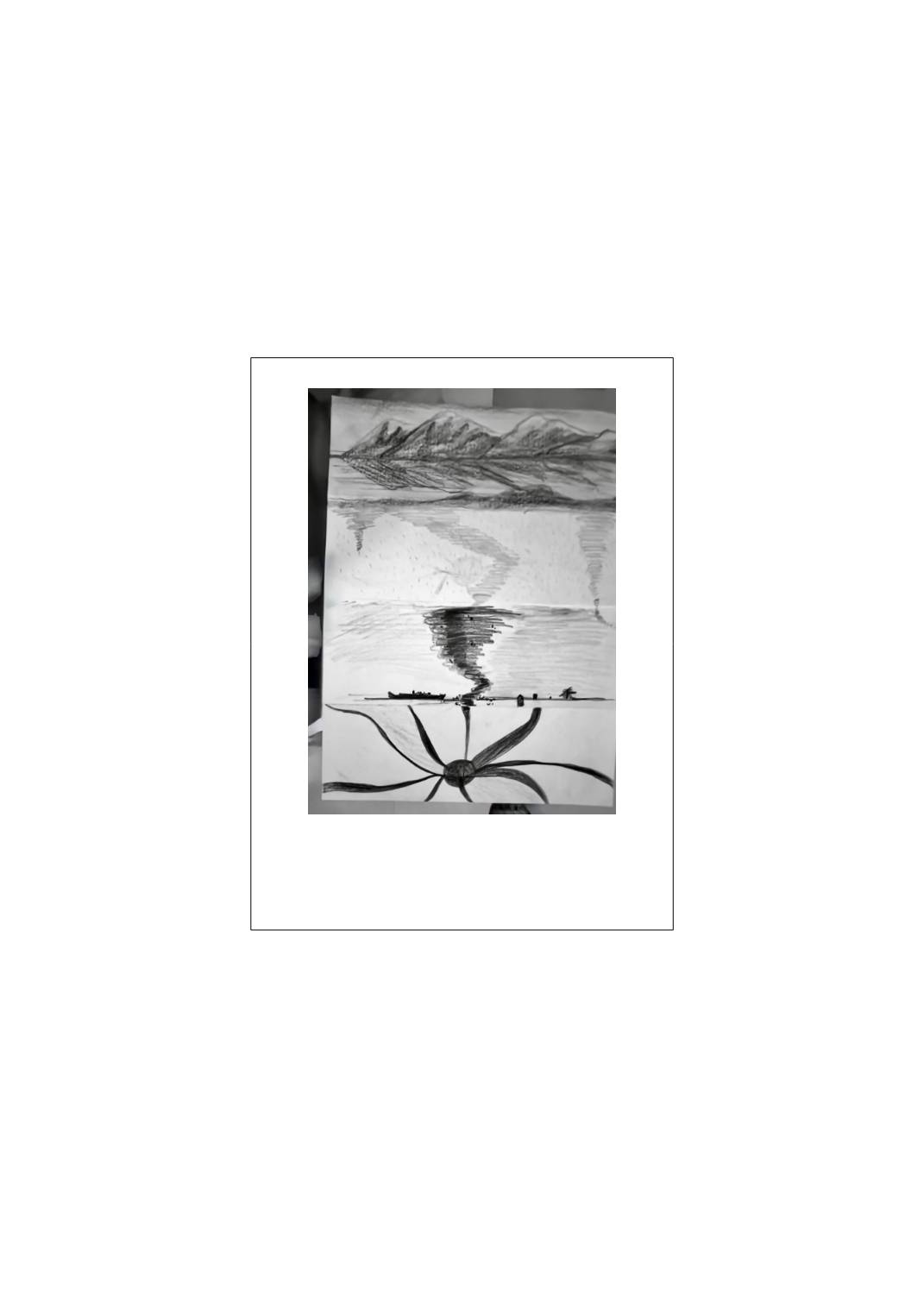
“Landscape of the Mind”
© MB
Not Dead Yet? is a multidisciplinary arts project centred on the experiences of
people living with incurable cancer and those caring, or who have cared, for a loved
one with incurable cancer. It seeks to create opportunities for artistic expression,
collaboration, and conversation, placing lived experience at the heart of the creative
process.
 Page 3 of 40
Read page 3 as text
Context and purpose
1
Original intentions and development
1
Refining the project’s focus
1
Participating artists
2
Preparing for the residency
3
Documentation and further evaluation 5
The Residency
5
Day One - Collaborative Making:
Drawing
6
The Landscape of the Mind
6
Seeing the whole for the first time 7
Creating a shared manifesto
8
Identifying Themes
11
Day Two - No longer strangers
13
Collaborative Making: Clay
13
The Vessel
13
From Themes to Artwork
19
Artists’ Proposals
19
Collaboration
21
Proposed structure
23
Closing Day Two
25
Day Three
26
Collaborative Making: Assemblage
28
Imagining the Exhibition
30
What next?
30
Participant feedback
32
Changes in confidence and
connection
32
What participants valued
33
Taking the work forward
33
Learning for future residencies
33
Acknowledgments
34
Index of Images
i
Table of Contents
 Page 4 of 40
Read page 4 as text
1 of 40
Context and purpose
Context and purpose
The three-day residency took place at Lighthouse Poole through Sanctuary 2026, a
program which provides space and support for artists across disciplines to develop
projects and nurture their creative practice.
Its emphasis on curiosity, experimentation, creative exchange, and
underrepresented artists provided a relevant setting for Not Dead Yet?.
This report will evaluate the residency against the intentions in the original
application and the aims of Sanctuary, while providing evidence for future funding
applications.
It brings together the project’s development, preparation, and opening activities;
participant feedback, as well as provide a map for further activity, resources, and
outcomes as a measuring tool of the success or otherwise of the project.
Original intentions and development
The application proposed bringing together up to ten people from BH and Dorset
postcode areas who had experienced cancer themselves or cared for a loved one
with cancer.
The intention was to build community, support expression through participants’
chosen creative media, and explore cross-discipline working.
Possible forms included textiles and/or fibre arts, writing, music, sculpture, painting,
film, photography, and mixed media.
Sanctuary 2026 offered an opportunity to develop the concept and begin making
work for a future exhibition, helping local people explore and understand different
experiences of cancer.
It also proposed encouraging the use of reclaimed materials, including materials
sourced through organisations such as Dorset Scrapstore.
Refining the project’s focus
The original application took a broader approach to experiences of cancer.
As the concept developed, the author —and project lead— chose to focus on
people living with incurable cancer and those caring, or who had cared, for a loved
one with incurable cancer.
 Page 5 of 40
Read page 5 as text
2 of 40
Context and purpose
This decision grew from her own experience of living with an incurable cancer
diagnosis and the challenges it presents, both in her creative practice and in
everyday life.
The freedom to shape the residency allowed for a more focussed exploration of a
very specific lived experience of cancer, creating space for participants to express
their individual realities through different artistic disciplines.
Collaborative and multidisciplinary creativity
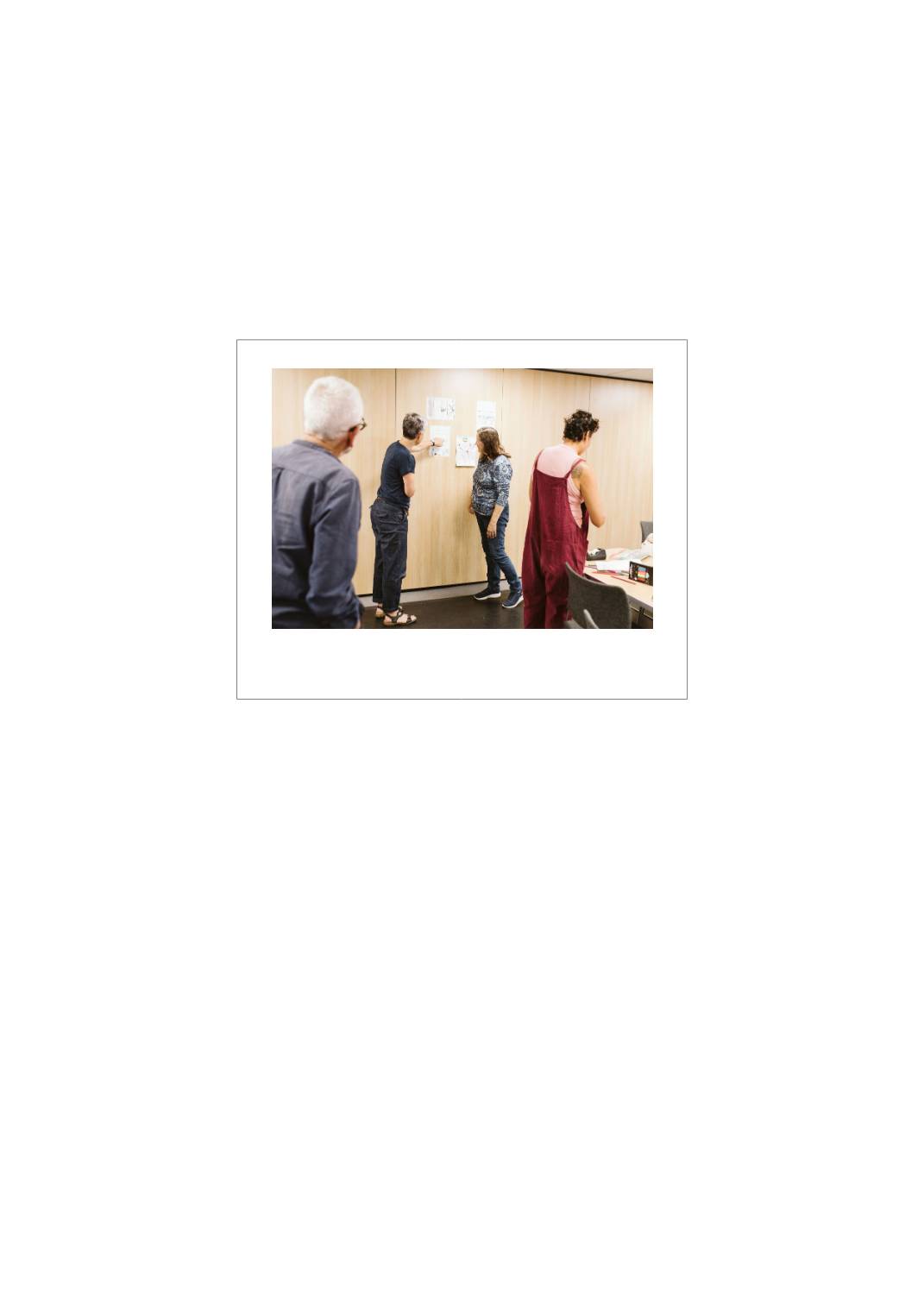
© AS
Participating artists
A recruitment and selection process, disseminated through social media, local
cultural networks, cancer charities, and in-person presentations to target groups, ran
from late June until late August.
The recruitment criteria invited applications from artists and creatives who were/had:
•
aged 18 or over
•
working in any creative/artistic discipline
•
living with incurable cancer or caring for, or have cared for, someone living with
incurable cancer
•
a clear connection to the Dorset geographical area, which included the following
postcodes BH, DT, SP7, and SP8 (Shaftesbury and Gillingham).
 Page 6 of 40
Read page 6 as text
3 of 40
Context and purpose
Prospective applicants were made aware that subject to successful funding/
fundraising, there would be capacity for a small payment in recognition of their
professional practice, creative contribution and lived experience.
Four artists, including the author, took part in the residency. All four attended each
of the three days. Together representing the following creative practices and
professional experiences:
•
An impressionist painter;
•
An emeritus professor in cinematics;
•
A poet and multimedia artist; and
•
A social scientist and documentarist with an interest in visual arts.
Preparing for the residency
Participants were given choices on consent regarding photography, filming, audio
recording, identification, and the use of project documentation.
The Wellbeing and Safeguarding protocol set out that participation did not require
disclosure of personal or medical information, personal choice, confidentiality,
emotional support, and responses to distress or safeguarding concerns.
The week before the residency, participants
took part in an online session ahead of
meeting in person. Everyone had an
opportunity to introduce themselves, ask
questions, and meet Kathy Lett, a BACP
registered psychotherapist supporting the
project.
This session served the purpose of
explaining what participants could expect
from the there-day residency and to set and
manage expectations.
Follow up communications included
providing participants with details of the
project’s wellbeing and safeguarding
protocol, participation consent form, and a
pre-residency reflection.
“Uniqueness
of opportunity to
meet and work
with other people
with whom there is
some shared
experience, albeit
no doubt other
important
differences
too.”
 Page 7 of 40
Read page 7 as text
4 of 40
Context and purpose
It recognised different energy levels, communication styles, and ways of
participating.
Participants were invited to share their hopes, concerns, and participation needs, as
well as their opinion as to what would make the residency a worthwhile experience
for each of them.
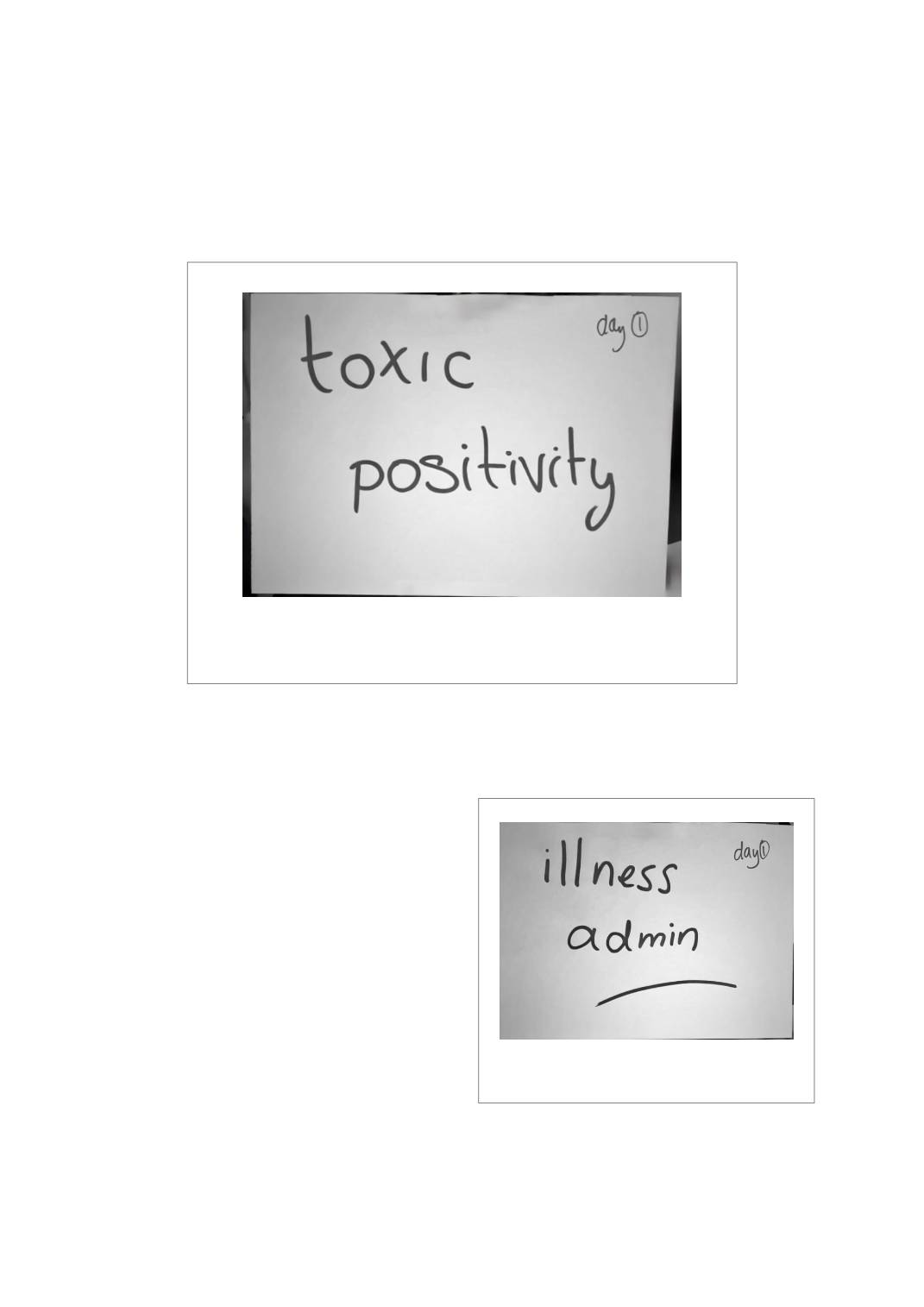
Toxic positivity, often experienced by participants
© MB
Questions about creative confidence,
connection to other artists, and comfort
exploring lived experience through
creative practice provided a framework
against which post-residency feedback
could be considered
Naming experiences
© MB
 Page 8 of 40
Read page 8 as text
5 of 40
Context and purpose
Bringing four people together with such
varied skills and experiences, could not
simply rely on the commonality of
cancer and creativity. It needed
meticulous planning to ensure the time
and space available could be maximise,
without jeopardising the main goal of
the project, to make artworks that
challenge the preconceived notions of
life with incurable cancer.
The project lead set out a schedule of
collaborative making across the three
days, involving drawing, clay and
assemblage. The participants were
given a detailed schedule though they
were mostly “blind” as to what each
activity entailed.
The Residency
Documentation and further evaluation
We were joined throughout the three days by Alexandra Szigeti, a Dorset-based
photographer who committed her time and skills to document the residency and the
artist’s interactions.
Additional photography was undertaken by the project lead, to include activity,
participants’ interactions, work in progress, and to serve as aide memoire and
evaluation tool.
Completed consent and reflection forms, financial records, and further creative
documentation form part of the project’s archive as background reference for future
concept and project development.
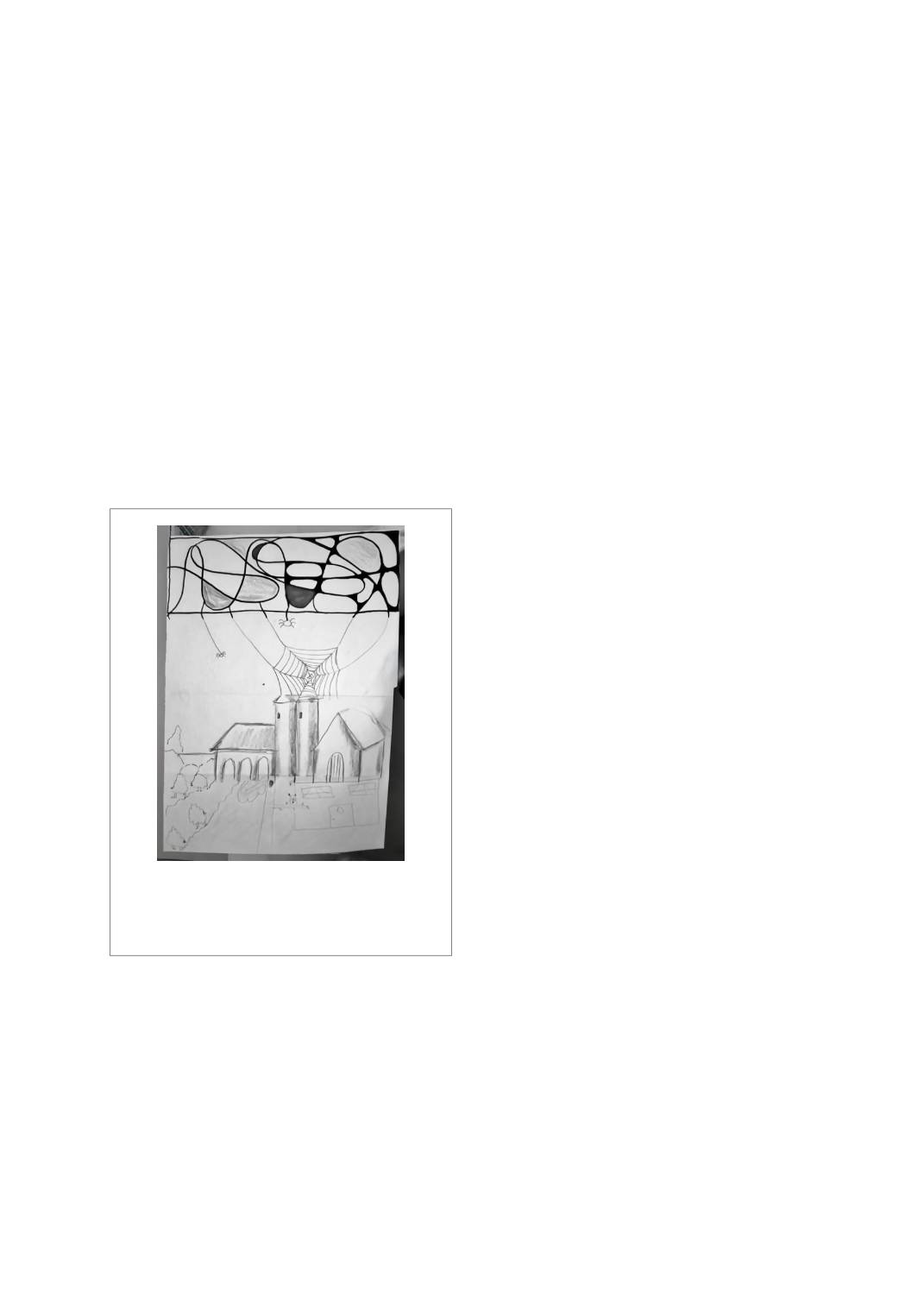
Individual marks merge into a shared drawing
© MB
The activities were intended to create a playful way for participants to experience
making, responding, relinquishing control and building on one another’s ideas before
moving into the day’s wider creative work.
They formed a loose framework and their meaning was left open so that participants
could bring their own interpretations, supporting the group in identifying and
shaping the themes which emerged as the residency progressed.
 Page 9 of 40
Read page 9 as text
6 of 40
Day One
Day One - Collaborative Making: Drawing
The Landscape of the Mind
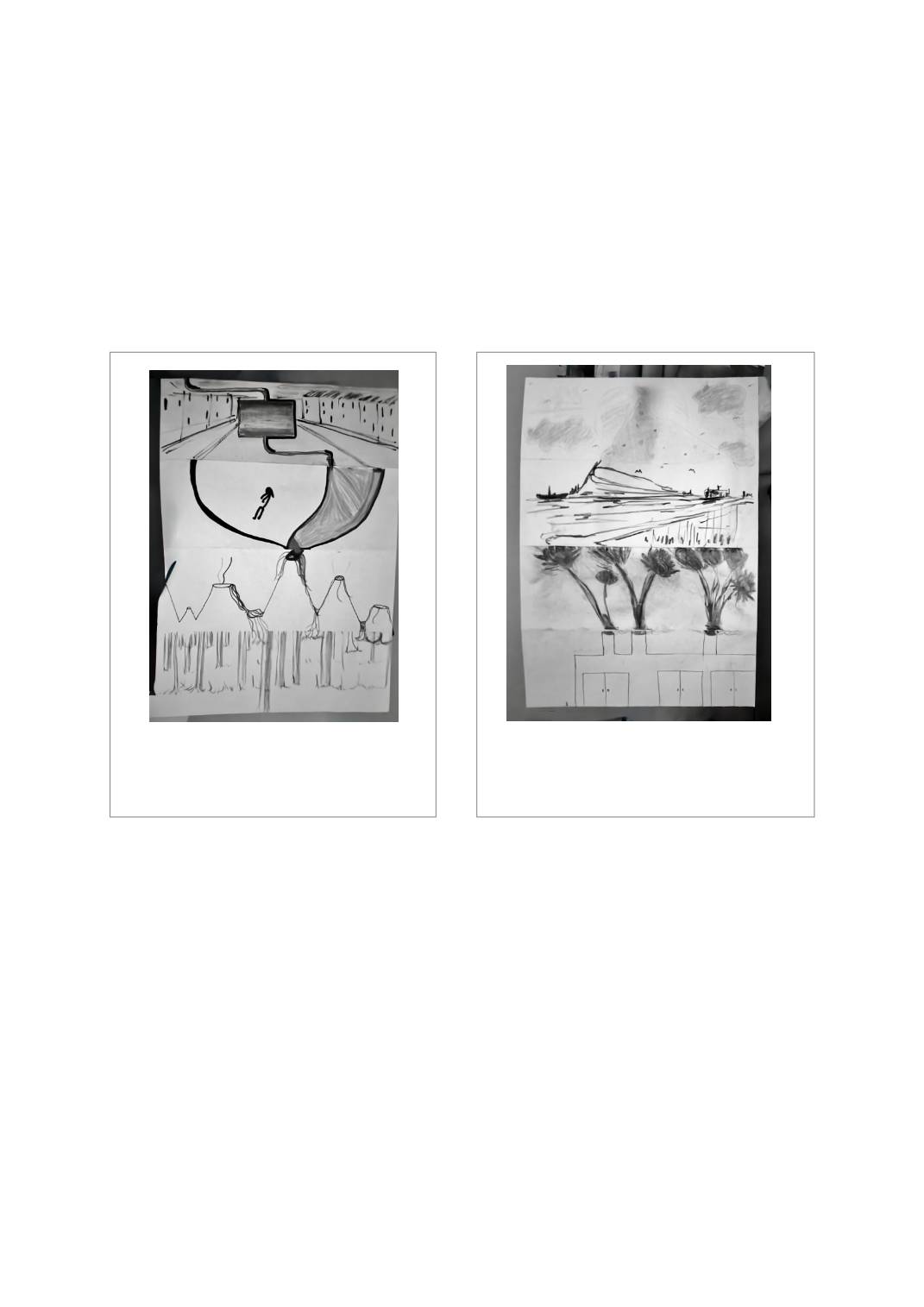
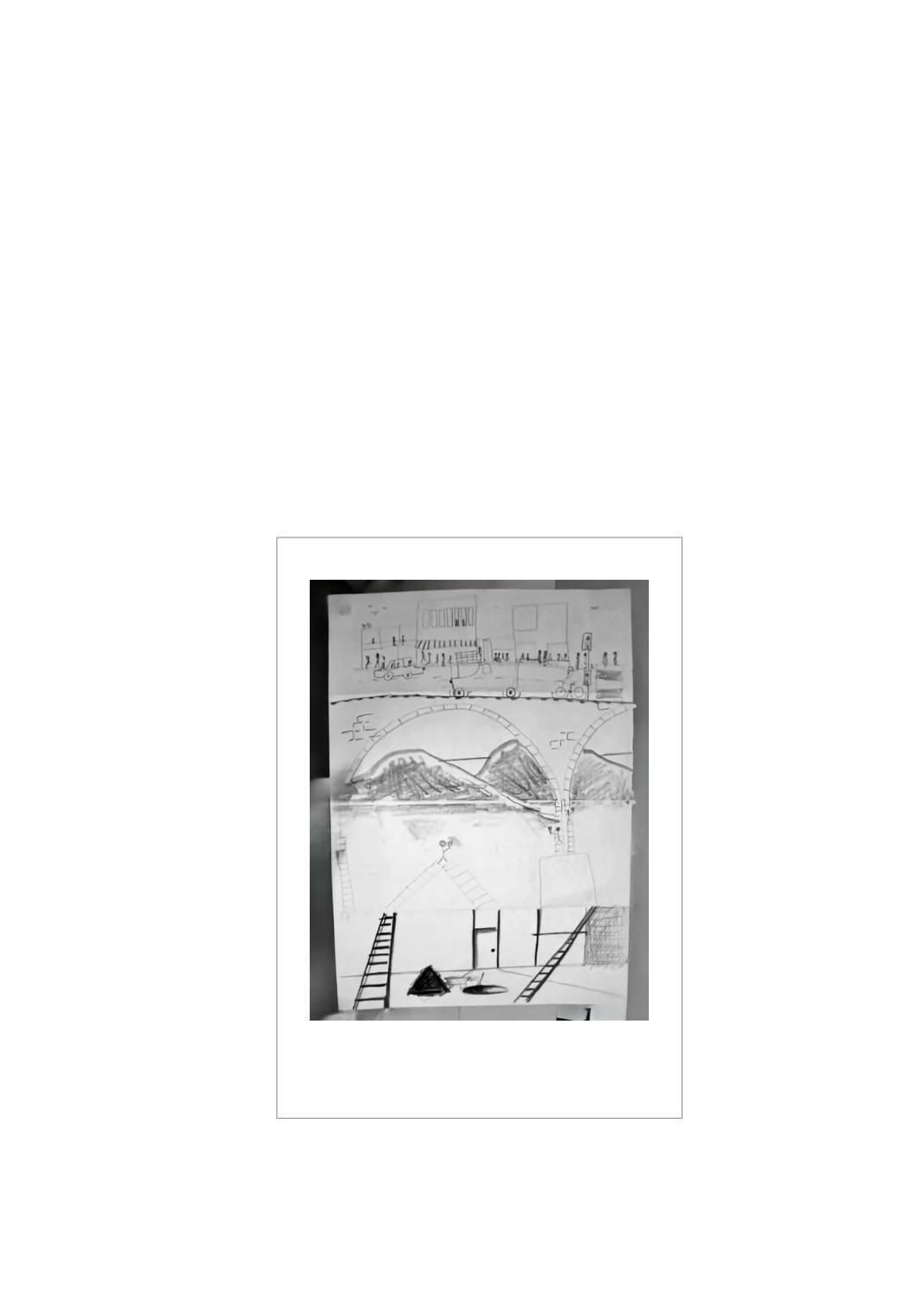
The residency opened with “Landscape of the Mind” a drawing activity with a focus
on connection, interpretation, and collaboration. Each participant received an
accordion-folded sheet of paper with four to six panels. A choice of accessible
drawing materials was provided, including soft graphite pencils, charcoal, soft pastel
sticks, easy-grip markers, and colouring pencils.
Participants were asked to respond to the prompt:
“We are going to start by making something together without knowing where
anybody else is taking it. Think of this as a landscape, real, imagined, or completely
abstract. You only need to respond to the marks that reach you.”
The activity introduced the idea of creating together without a predetermined
outcome, with participants responding to one another’s marks through their own
visual choices.
The purpose was to gently introduce the artists to working collaborative in an
activity that required no preparation, only basic drawing skills, and evoked childhood
pursuits.
Drawings reveal everyone’s contribution
© MB
“Circulation”; a common theme identified
© MB
 Page 10 of 40
Read page 10 as text
7 of 40
Day One
Seeing the whole for the first time
Process and shared reflection
Each participant had approximately two to three minutes to draw before concealing
their contribution and passing the sheet to the next person to continue the drawing.
Once each sheet was full, having passed through every participant’s hands, the
resulting drawings were revealed and displayed for everyone to see. Together, we
analysed each drawing and listened to one another’s feedback, noting unplanned
similarities and contrasts in styles and patterns.
The activity explored “not being in control” and how creating “blind” influenced each
person’s ability to create.
Our reflections connected this experience with living with our individual cancer
diagnoses, prognoses, and treatment, identifying common themes of uncertainty,
limited control, and having to respond to what unfolds.
Diverging direction of travel
© MB
 Page 11 of 40
Read page 11 as text
8 of 40
Day One
Creating a shared manifesto
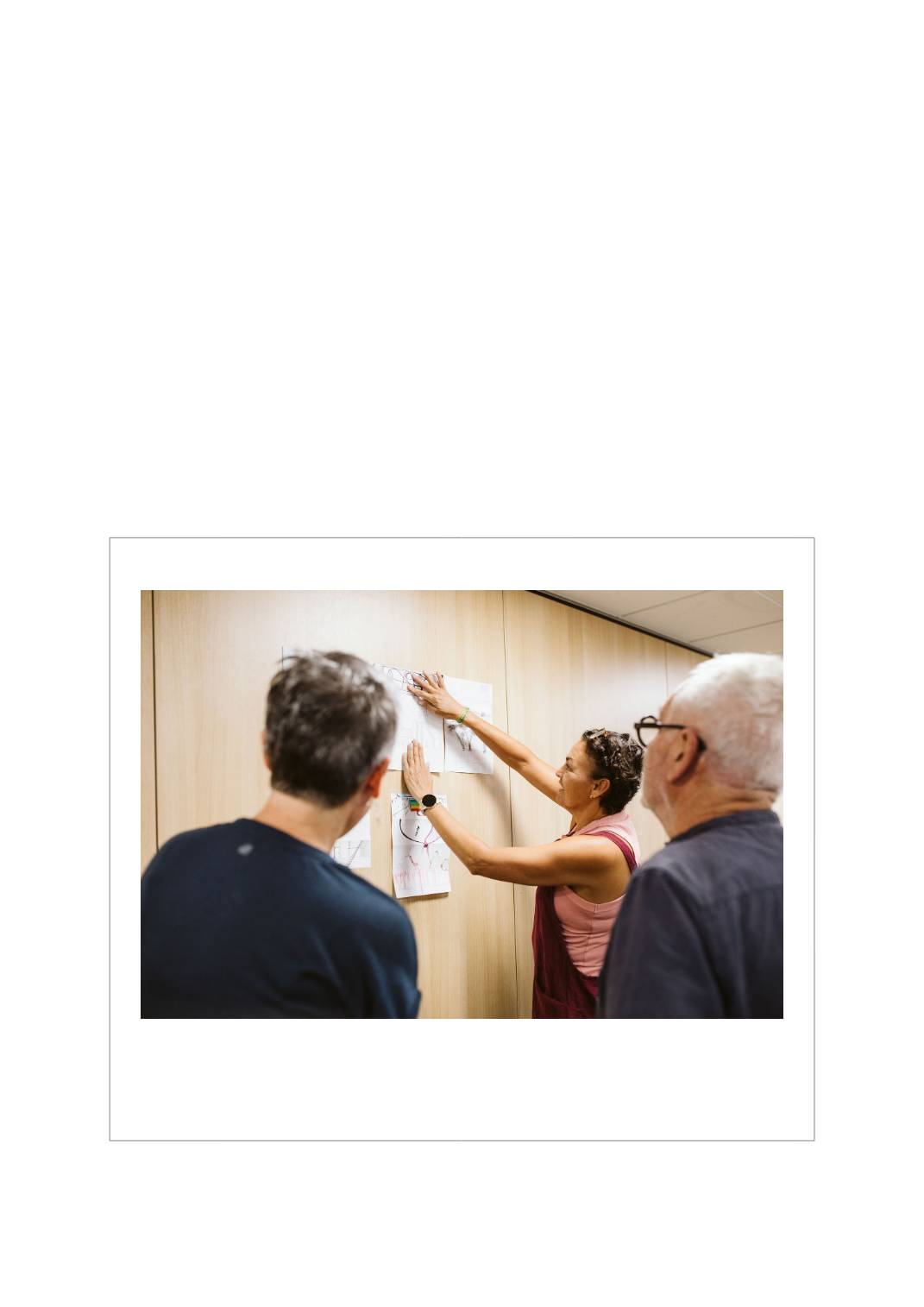
Having “broken the ice” with an initial creative activity, participants were encouraged
to formulate the residency manifesto collaboratively, beginning with the question:
“What do I need from the people in this room to be able to participate fully and
creatively?”
Responding to prompts
© AS
Documenting ideas
© AS
Organising ideas
© AS
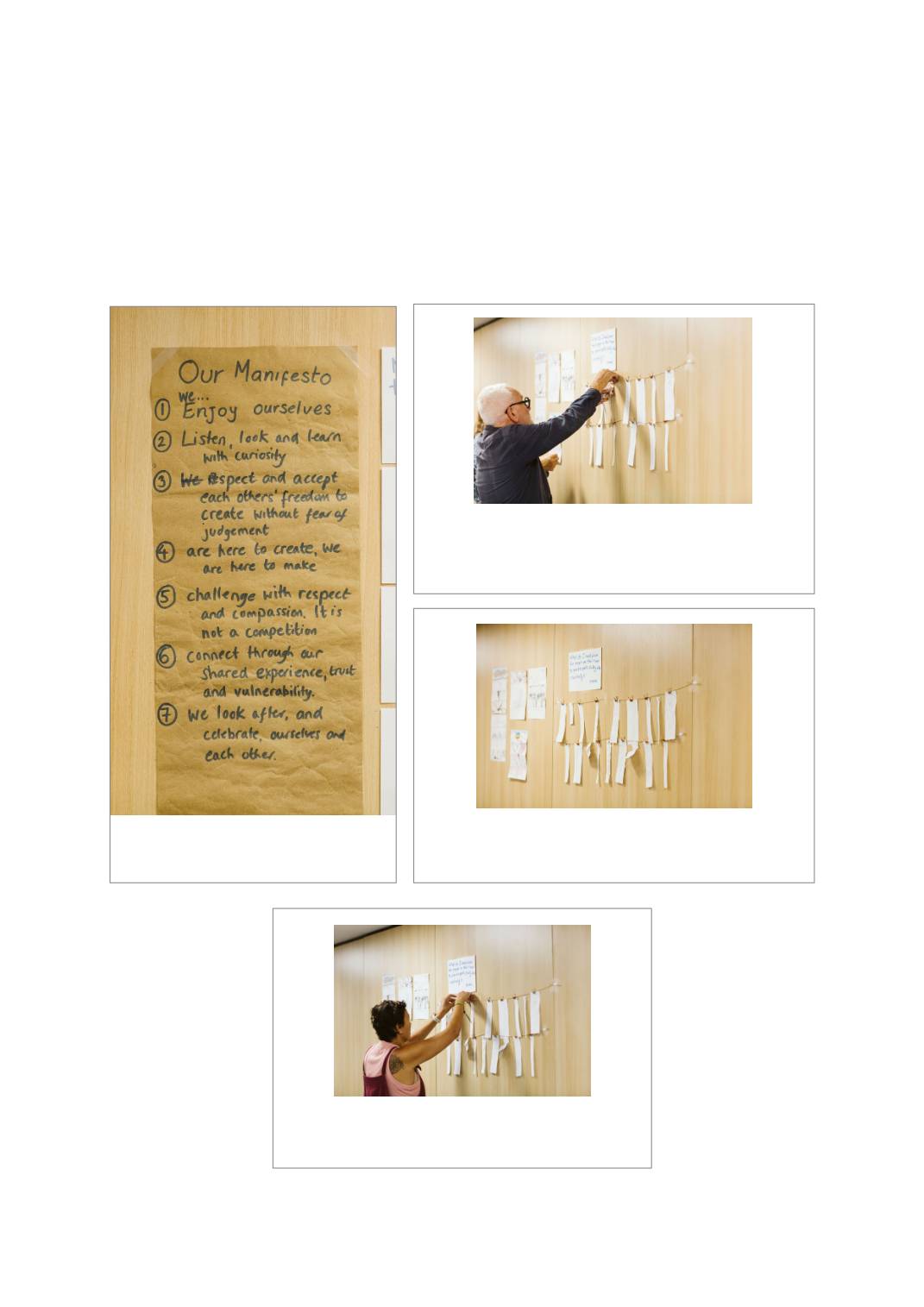
Our Manifesto
© AS
 Page 12 of 40
Read page 12 as text
9 of 40
Day One
We:
1. Enjoy ourselves.
2. Listen, look, and learn with curiosity.
3. Respect and accept each other’s freedom to create
without fear of judgement.
4. Are here to create; we are here to make.
5. Challenge with respect and compassion; it is not a
competition.
6. Connect through our shared experience, trust, and
vulnerability.
7. Look after, and celebrate, ourselves and each other.
8. Accept that language and expression include the
use of expletives, such as swearing.
Each participant wrote their answers on separate pieces of paper, which were hung
on a clothes line using pegs, grouping responses with similar themes, which were
then used to formulate collective statements.
The eighth clause was added late on the final day.
This process gave everyone an opportunity to express their needs and contribute to
the principles guiding our time together.
The resulting manifesto provided a shared reference point for how we wanted to
participate, create, and work alongside one another.
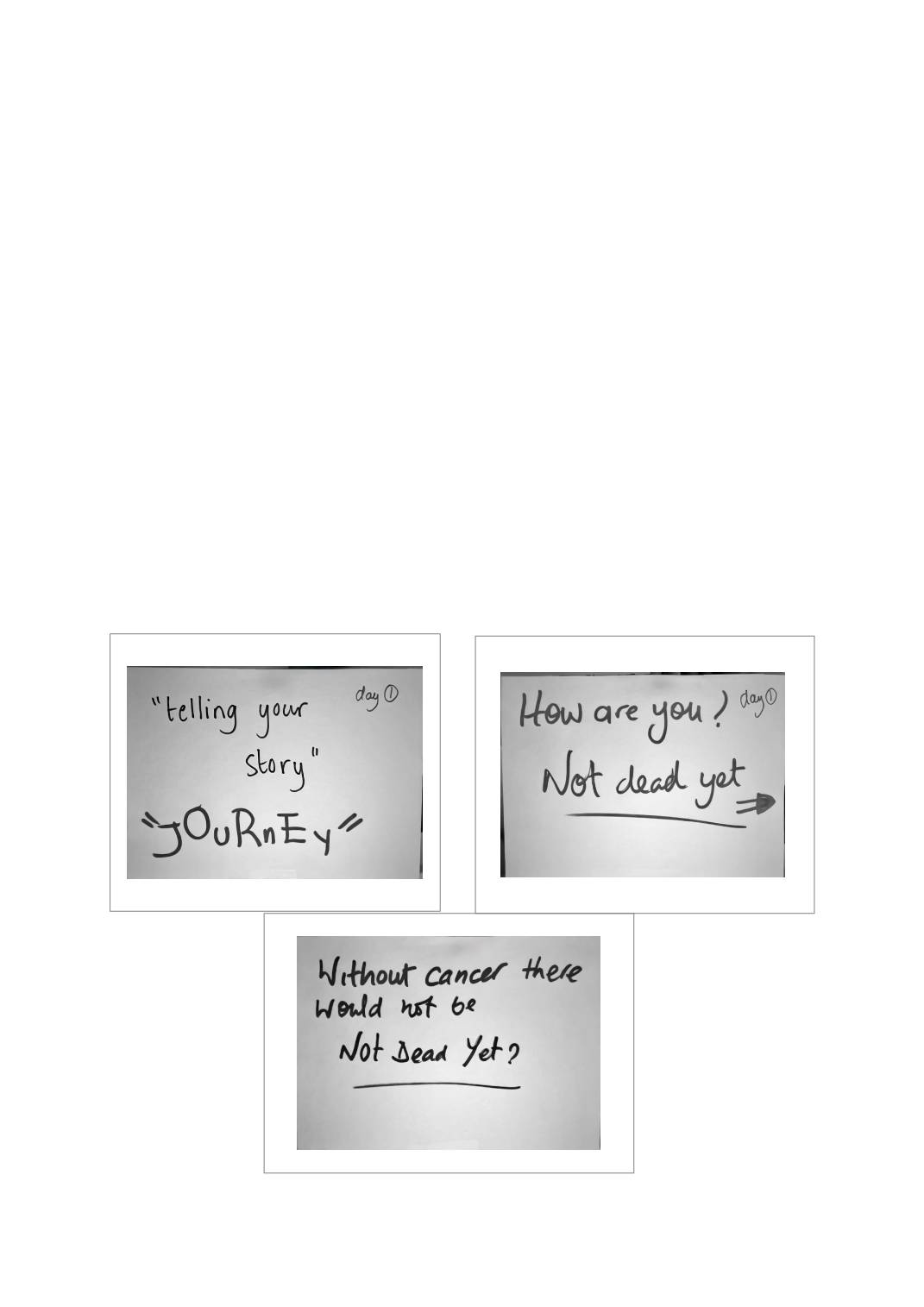
Day 1 ended with a reflection, framed by the questions overleaf, on what had been
achieved and what was to come for the following day.
 Page 13 of 40
Read page 13 as text
10 of 40
Day One
End of day one reflections
© AS
What these words or ideas mean to us in practice?
Are any of these saying something similar?
Is anything important missing?
What would help us disagree without dismissing one another?
What would help someone say they need a break, more time, or a
different way to participate?
 Page 14 of 40
Read page 14 as text
11 of 40
Day One
Identifying Themes
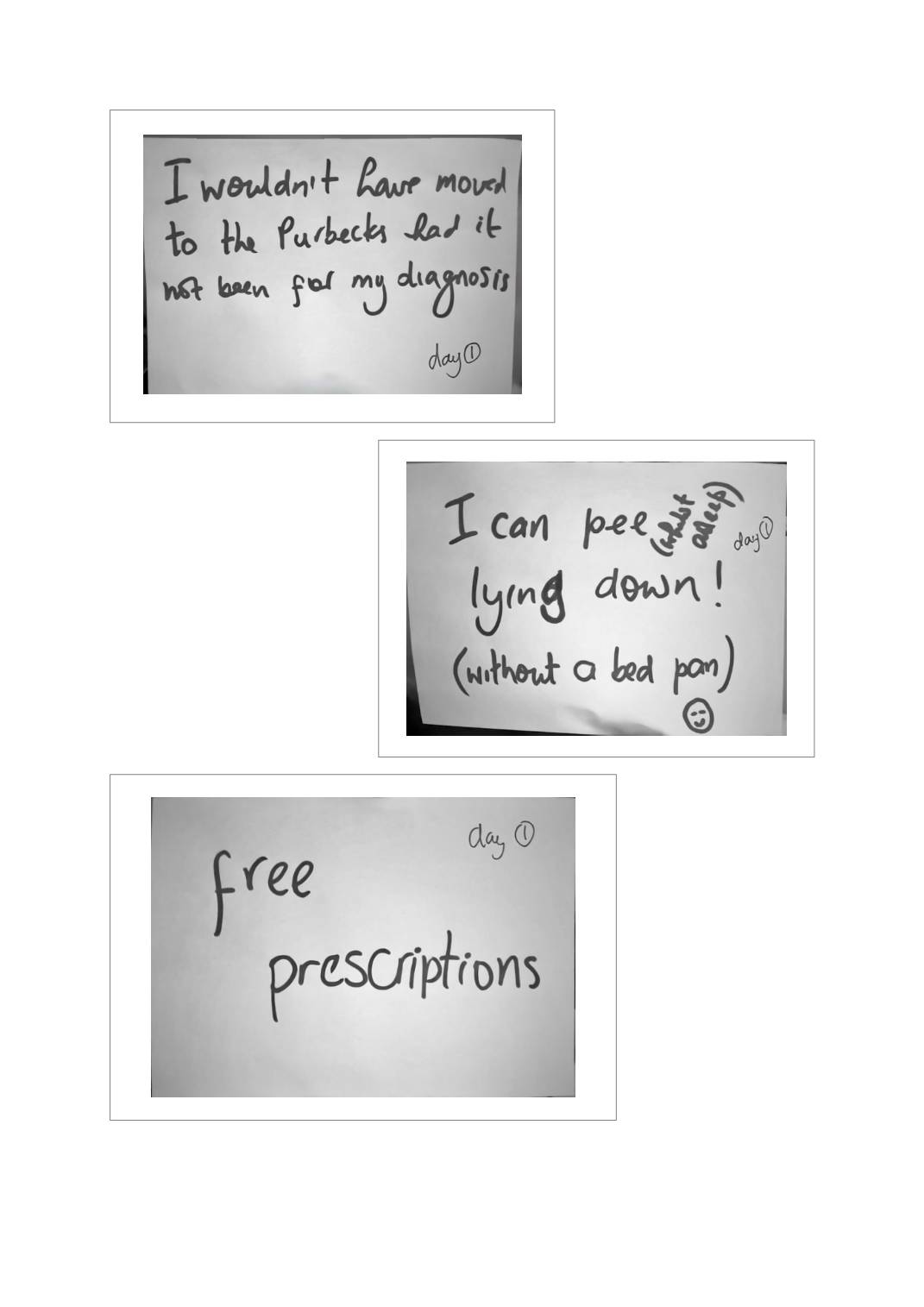
To help identify themes emerging from our initial discussions the project lead asked
participants to think about their experiences of living with incurable cancer, noticing
and documenting what felt:
•
Important
•
Infuriating
•
Niggling
•
Overlooked
•
Worth celebrating
The manifesto served as the base from which to engage in dialogue with each other,
bearing in mind that some of the topics that were likely to arise would need to be
given room for empathy, compassion, respect, and acceptance.
The project lead explained that by identifying themes early on the residency it would
set the direction in which participants would want to take any creative work resulting
from the three days of collaboration.
 Page 15 of 40
Read page 15 as text
12 of 40
Day One
Connect through
our shared
experience, trust,
and vulnerability.
 Page 16 of 40
Read page 16 as text
13 of 40
Day Two
Day Two - No longer strangers
Returning to the Lighthouse for day two of the residency felt peculiar to all
participants; aware that we had spent a full day thinking, collaborating, creating,
analysing, and reflecting, the start of a new day with people we had only met in
person 24 hours before suddenly did not feel so strange. This is the feedback that
greeted the author that morning as we all settled with our preferred hot drink.
Before moving onto the scheduled activities of the day, participants were asked to
consider: “Is there anything we learned from yesterday that needs adding to our
manifesto?” The manifesto remained visible for anyone to recap, and consider
whether additions were needed.
The project lead was keen to move the residency from exploration towards
ownership, though the aim was not to leave with a fixed exhibition plan. Recording
selected themes, emerging individual intentions, possible collaborations, and a
materials/needs list, would contribute towards the goal of clarity without enforced
closure.
Collaborative Making: Clay
The Vessel
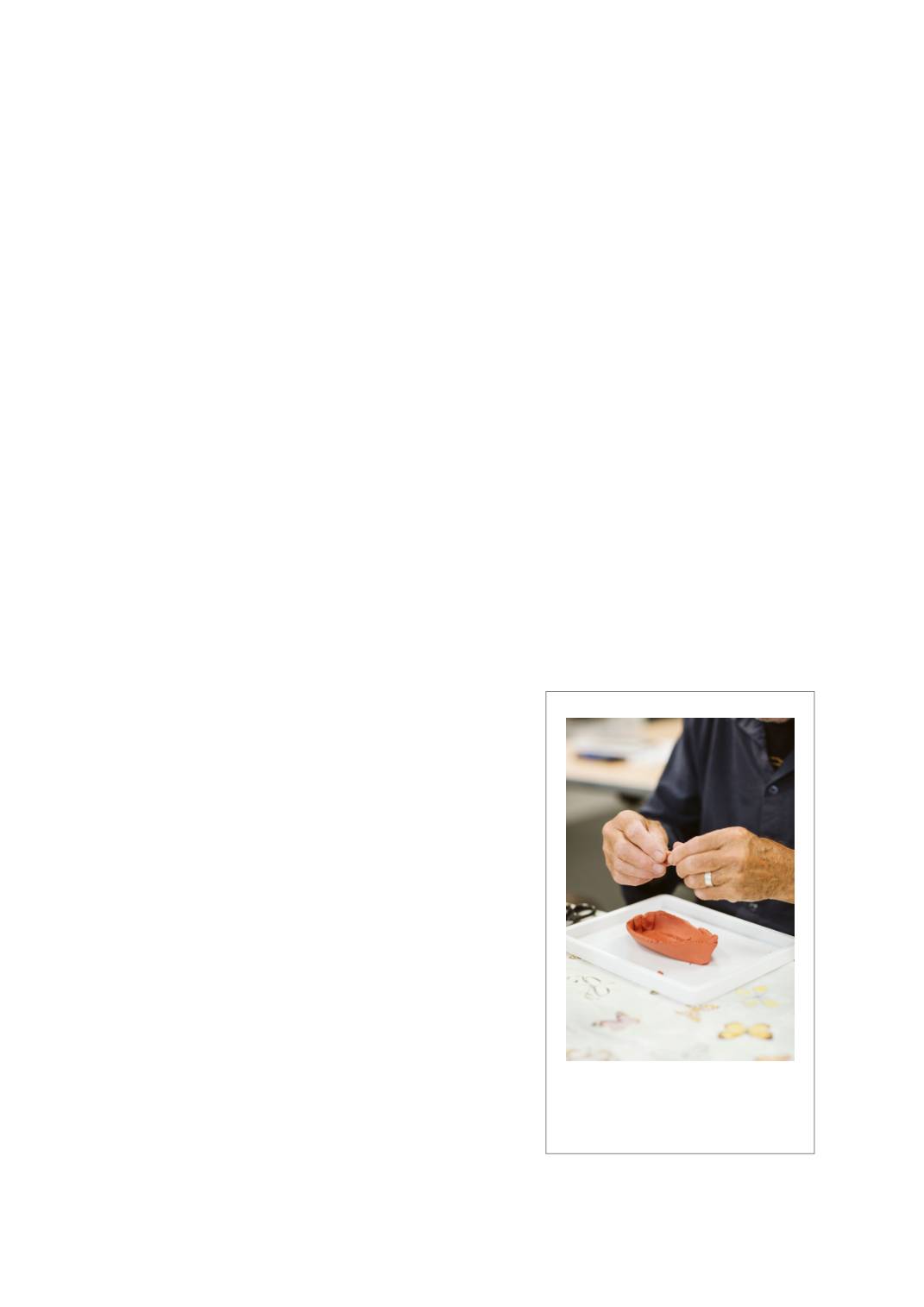
A collaborative creative activity focused on responding, adapting and adding without
erasing. Participants were given the same
quantity of air-dry clay, and invited to respond
to the following prompt:
“Today we are going to build something that
Adding to the “beginning”
© AS
changes every time it reaches another pair of
hands. Create a beginning — a base, hollow,
curve, wall, opening or form. It does not need
to represent anything”
Approximately three to five minutes were
allowed to begin creating a form, and
participants were instructed to pass their
“beginning” piece onto the person to their
right.
The person receiving it was instructed to
modify it only by adding to what was already
there rather than remove or destroy it.
 Page 17 of 40
Read page 17 as text
14 of 40
Day Two
Collaborative Making: Clay
© AS
“…a base, hollow, curve, wall…”
© AS
The following were optional/suggested actions:
“wrap, texture, extend, enclose, open up, or build onto the existing structure.”
This process was repeated until all of the beginning pieces had rotated and returned
to its original creator.
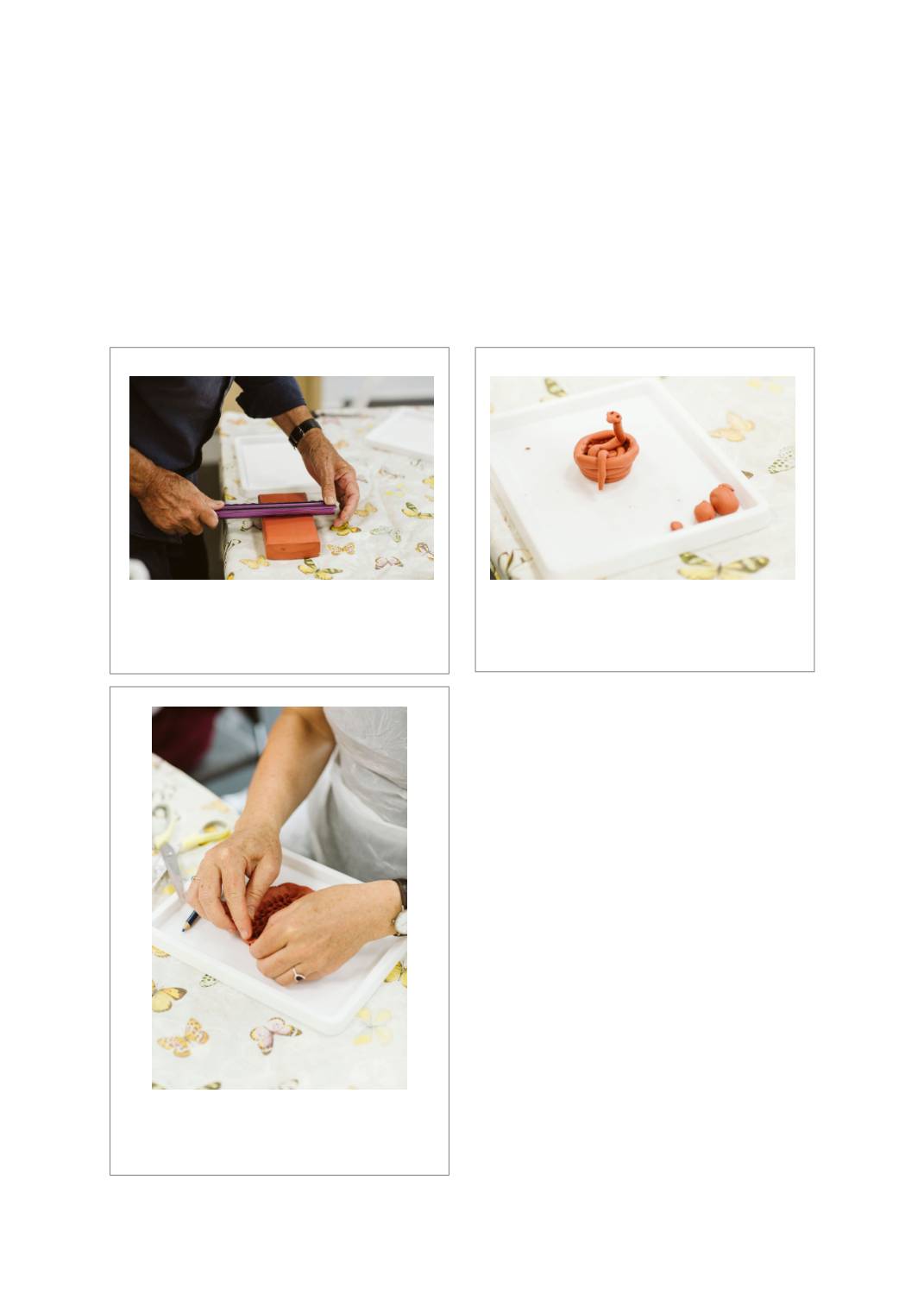
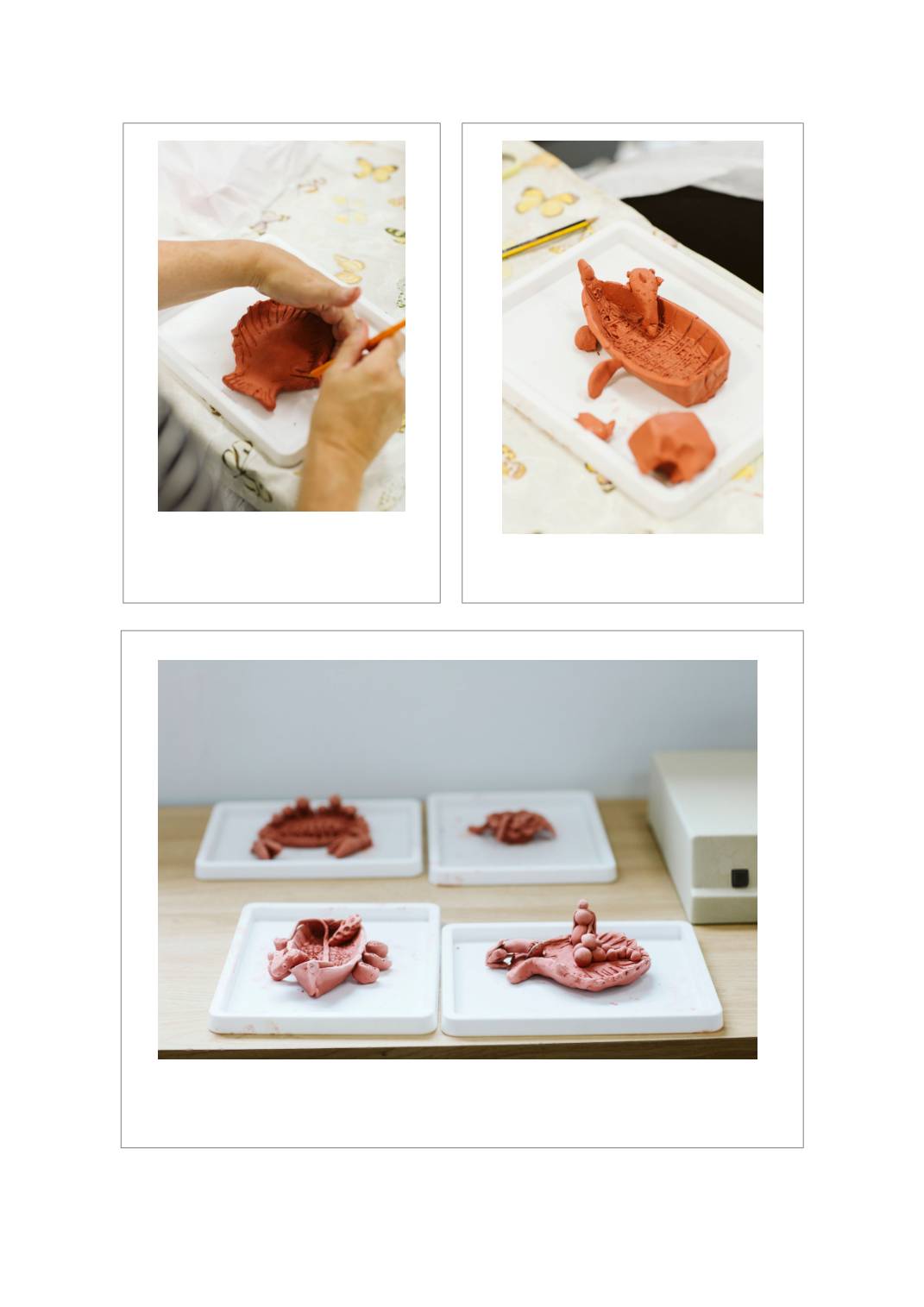
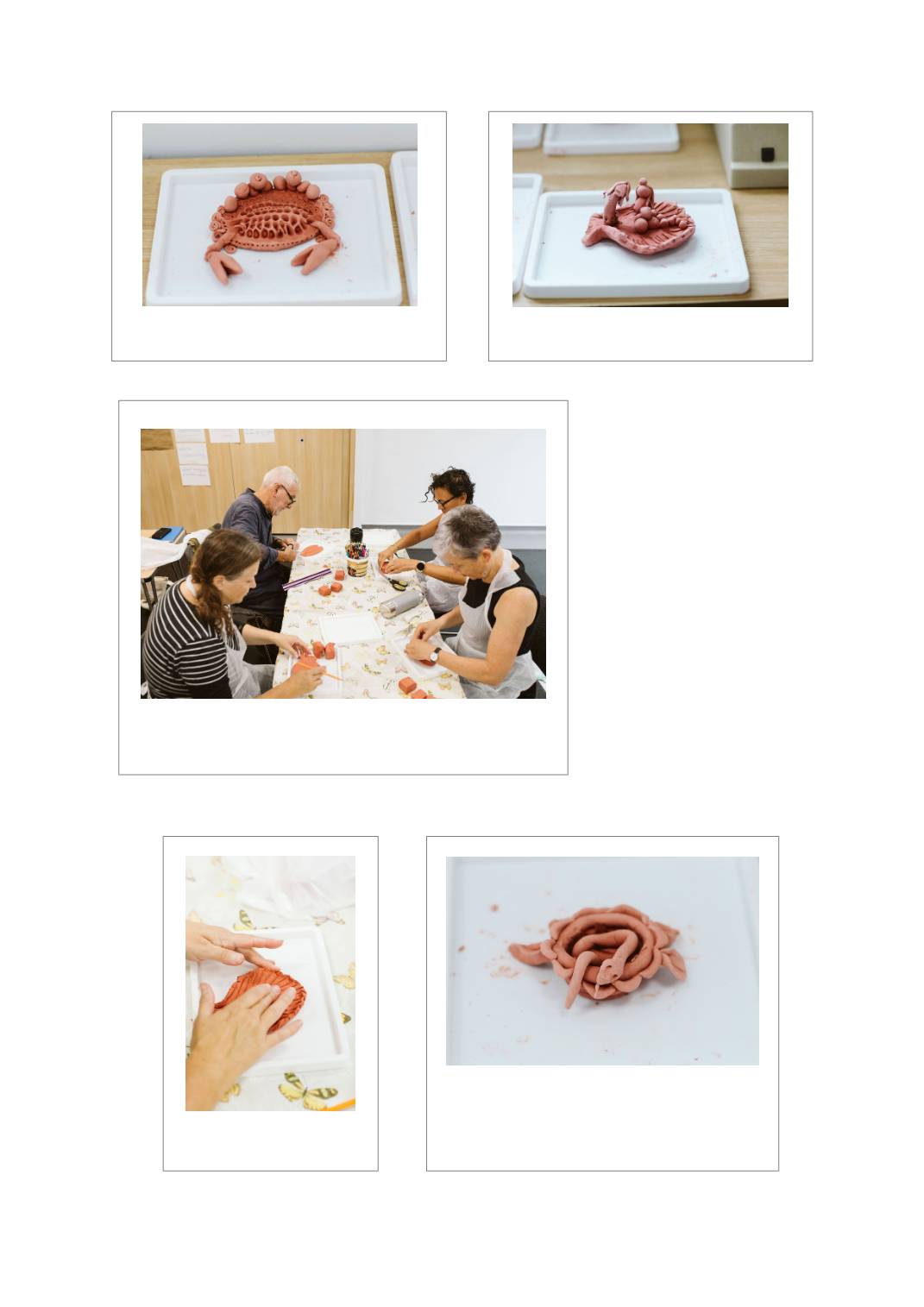
Four very different small scale clay “sculptures” were created, each evolving in
unpredictable directions as they were rotated around the table.
On completion, participants were invited
to reflect on this form of collaborative
creative activity.
These questions provided a framework
for reflection:
What was it like receiving something
somebody else had begun?
When did you follow the existing form
and when did you take it somewhere
unexpected?
What changed when you were asked to
add without erasing?
What does this tell you about
collaborating while retaining individual
creative voices?
The Vessel taking shape
© AS
 Page 18 of 40
Read page 18 as text
15 of 40
Day Two
Creating “The Vessel”
© AS
Four small-scale clay sculptures
© AS
A boat in clay
© AS
 Page 19 of 40
Read page 19 as text
16 of 40
Day Two
Creativity in clay
© AS
Is it a crab?
© AS
A stranded maid?
© AS
Hands moulding clay
© AS
A snake slumbers
© AS
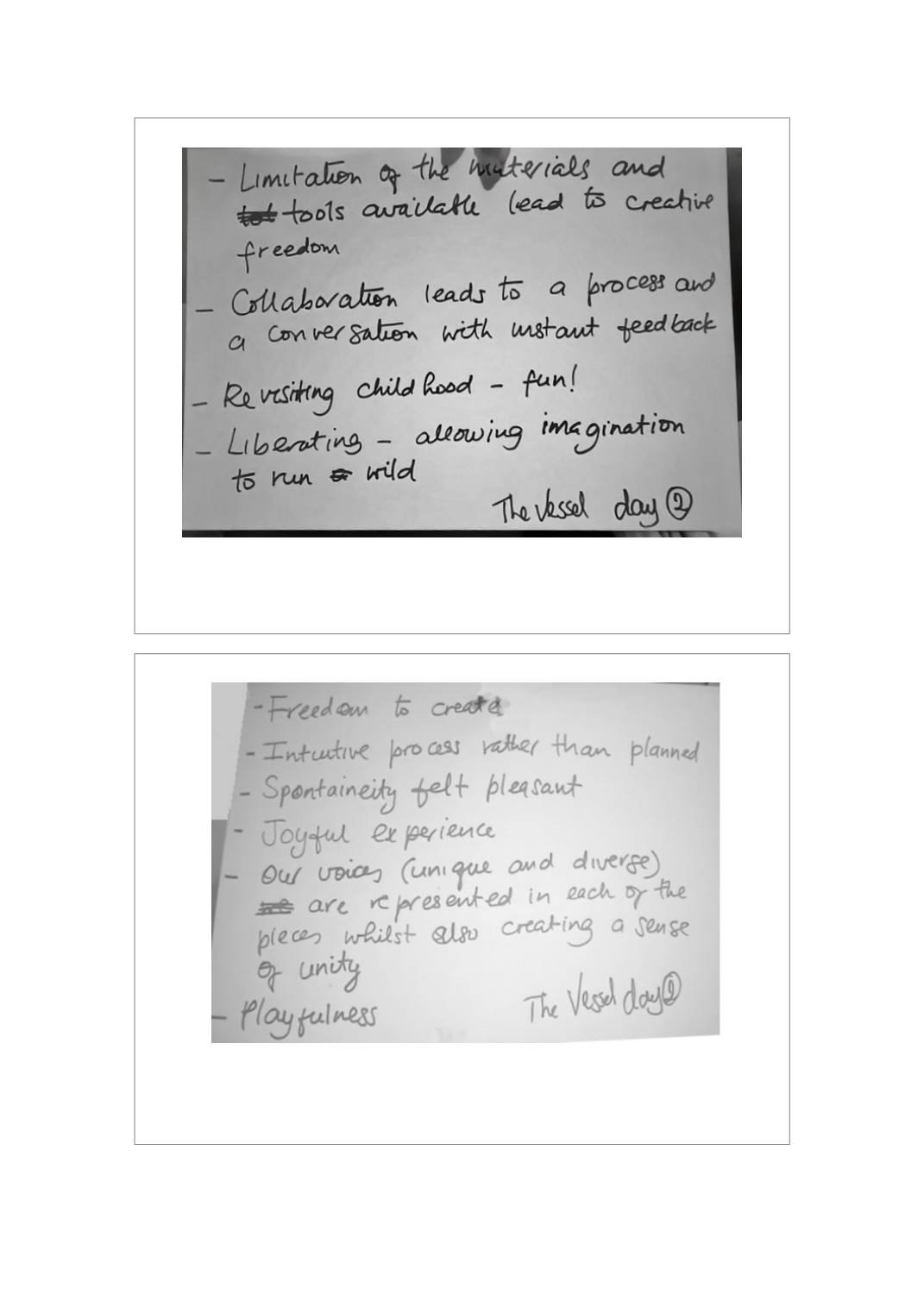
“Our voices
(unique and
diverse) are
represented in
each of the
pieces, whilst
also creating a
sense of unity”
 Page 20 of 40
Read page 20 as text
17 of 40
Day Two
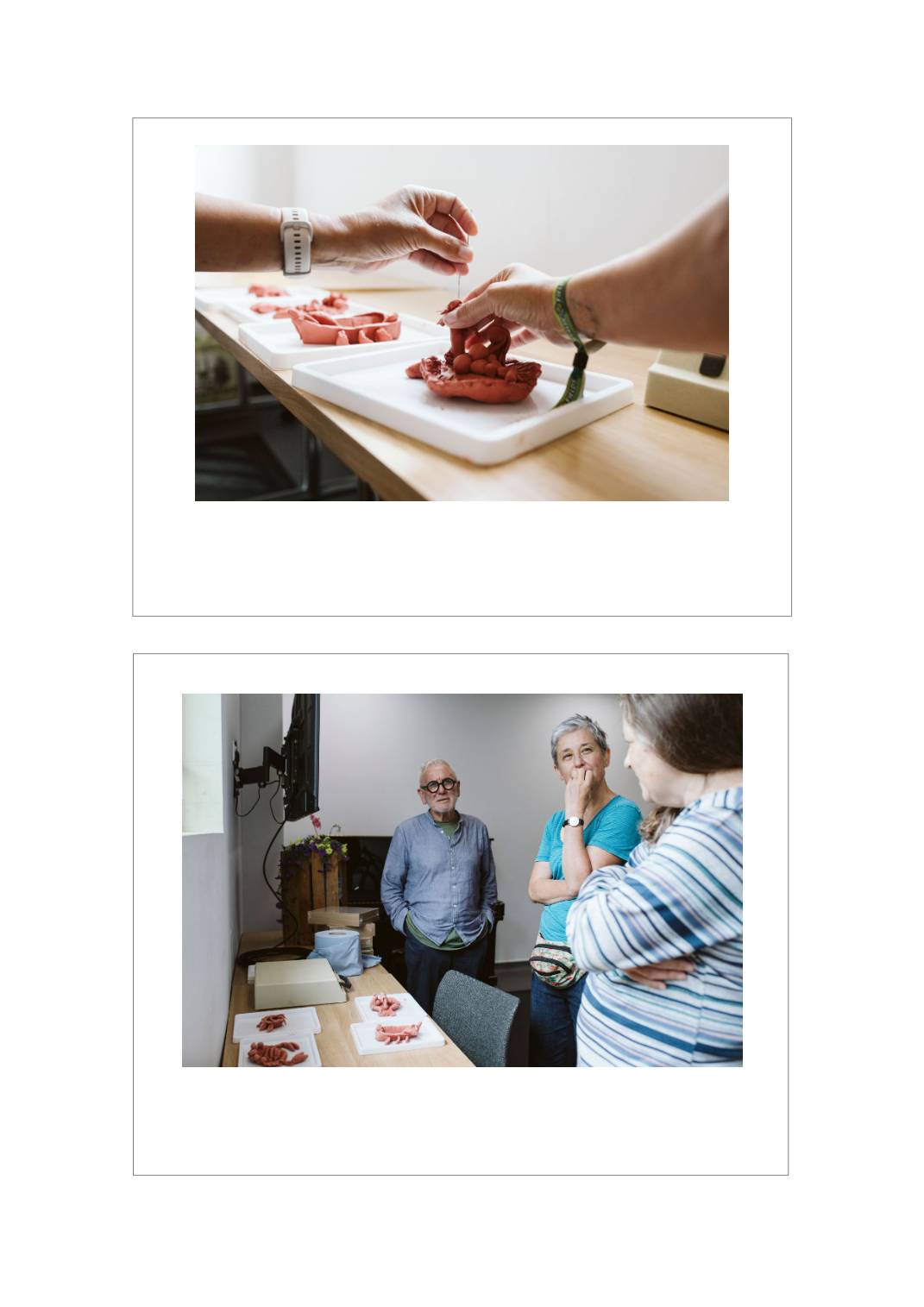
The finishing touches
© AS
Sharing reflections on creating with clay
© AS
 Page 21 of 40
Read page 21 as text
18 of 40
Day Two
Reflections on creating with clay
© MB
Reflections on creating with clay
© MB
 Page 22 of 40
Read page 22 as text
19 of 40
Day Two
From Themes to Artwork
Artists’ Proposals
The project lead had set out a firm intention that outputs from the residency should
be artist-lead, born from experimentation and exploration, and shaped through
connection and collaboration.
Having experienced three collaborative creative activities, “The Landscape of the
Mind”, “Our Manifesto”, and “The Vessel”, the afternoon of day two was dedicated
solely to opening the space to each individual artist, inviting each of them to express
what, within the crossroads of incurable cancer and artistic expression, drew their
attention, what they wished to explore, what media and/or processes they could
imagine using.
Participants were reassured that this was simply an exercise of “what if” rather than
a commitment to follow through.
As project lead, the author’s role was to observe, listen, identify connections
between participants’ practices and ideas, scribe as needed, assist in expanding or
pinpointing concepts and context.
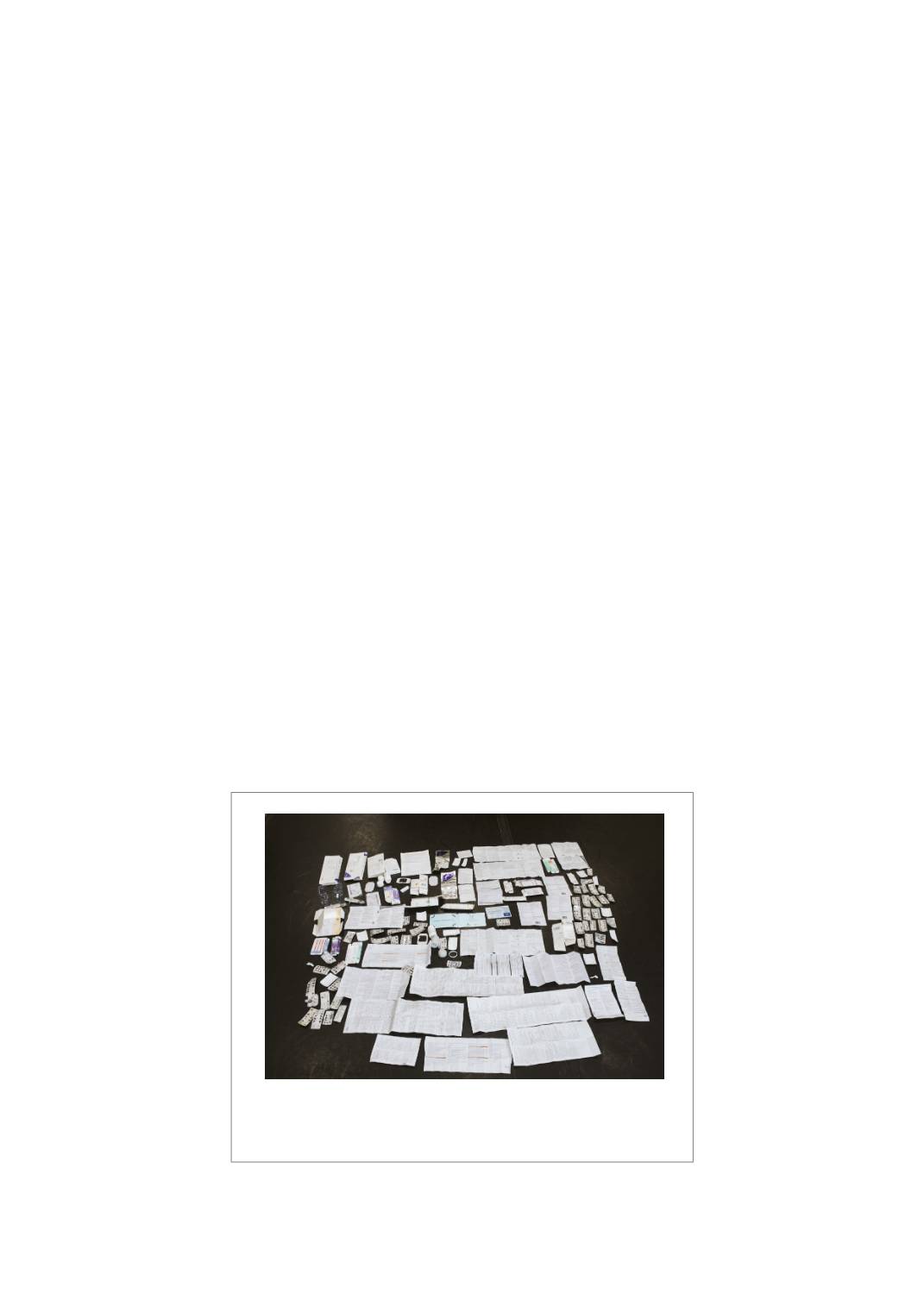
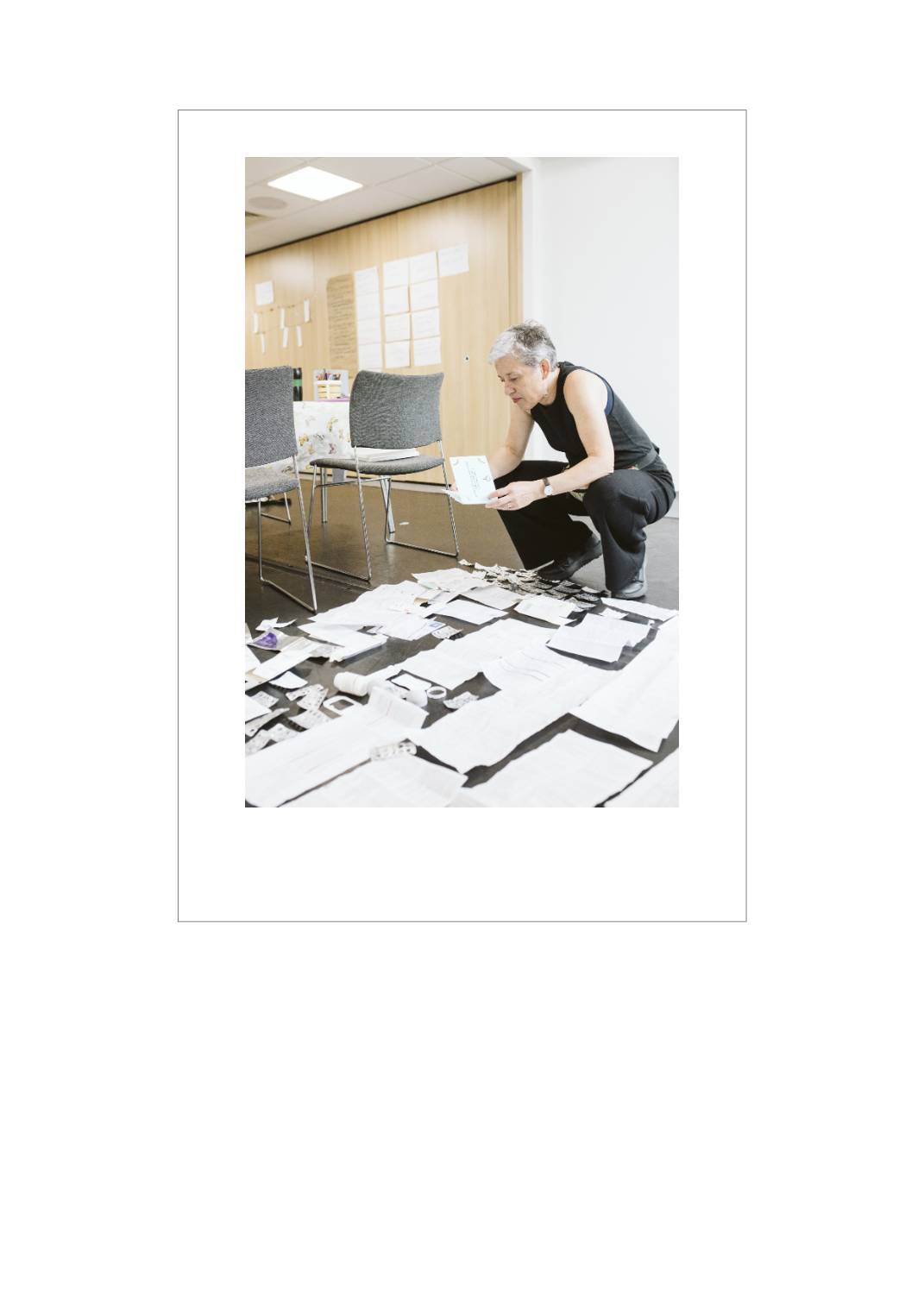
To facilitate the flow of ideas, the project lead offered as example her own
preoccupation with the environmental impact of her ongoing cancer treatment, by
displaying three months’ worth of medical packaging she had started to “save” as
partial evidence.
Which posed the question, “could all of this packaging be turned into artwork?” and
addressing the proposed project’s criteria of utilising reclaimed materials to create
artwork.
Three months’ worth of medicines’ packaging
© AS
 Page 23 of 40
Read page 23 as text
20 of 40
Day Two
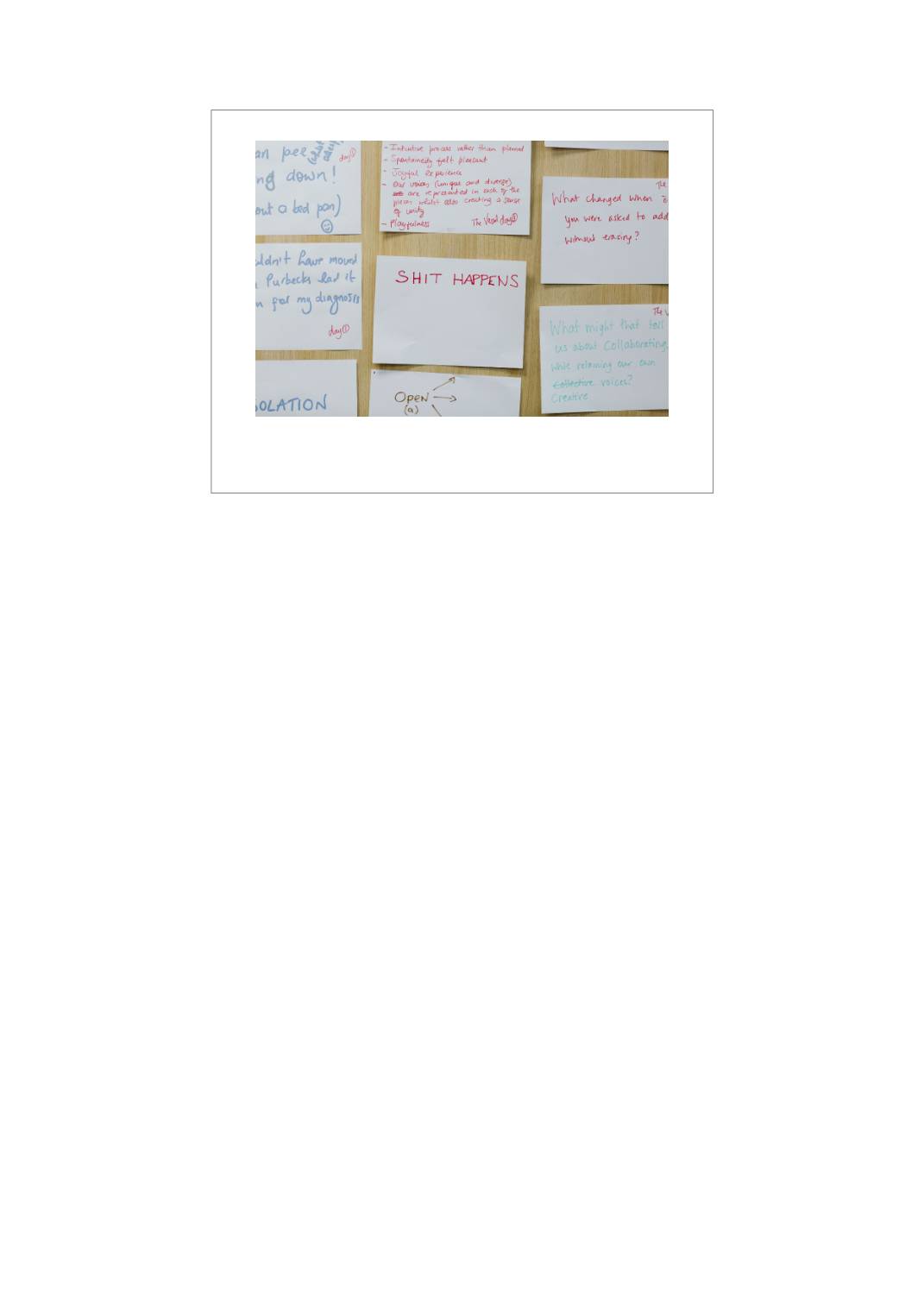
Participants all agreed that honesty about all facets of their experience of living with
incurable cancer was the starting point for any work to be produced.
It felt important to embrace humour as well, recognising that against all odds and
expectations, there have been positive facets to each of the participants’ own
perspective of being exposed to the health system.
Pondering the environmental impact of cancer care
© AS
 Page 24 of 40
Read page 24 as text
21 of 40
Day Two
The following questions guided this part of the day:
•
What feels like it wants to remain an individual piece of work?
•
Where might two or more practices meet naturally?
•
Could there be one collective piece, several smaller collaborations, connections
between individual works, or a mixture of all of those?
Collaboration
Discussions turned to collaboration and whether as a cohort we wanted to
implement a closed model or an open model of collaboration.
Whilst all participants agreed that it was an important aspect of the project, after
consideration of the advantages and disadvantage of each model, the consensus
became one of a more fluid model of collaboration, which evolves as the project
takes shape and ideas become tangible output.
Traditional collaboration models present challenges in engaging intended
communities, risking either artistic integrity or appearing insulated. Rigidity can also
stifle the future viability of the project.
Not Dead Yet? proposes an alternative collaborative model in which participation,
contributions and dialogue are layered and built upon in stages.
Honesty, a theme embraced by participants
© AS
 Page 26 of 40
Read page 26 as text
23 of 40
Day Two
The group shaped the structure of a possible future exhibition which would support
the development of collaborative and individual work.
Collaborative work
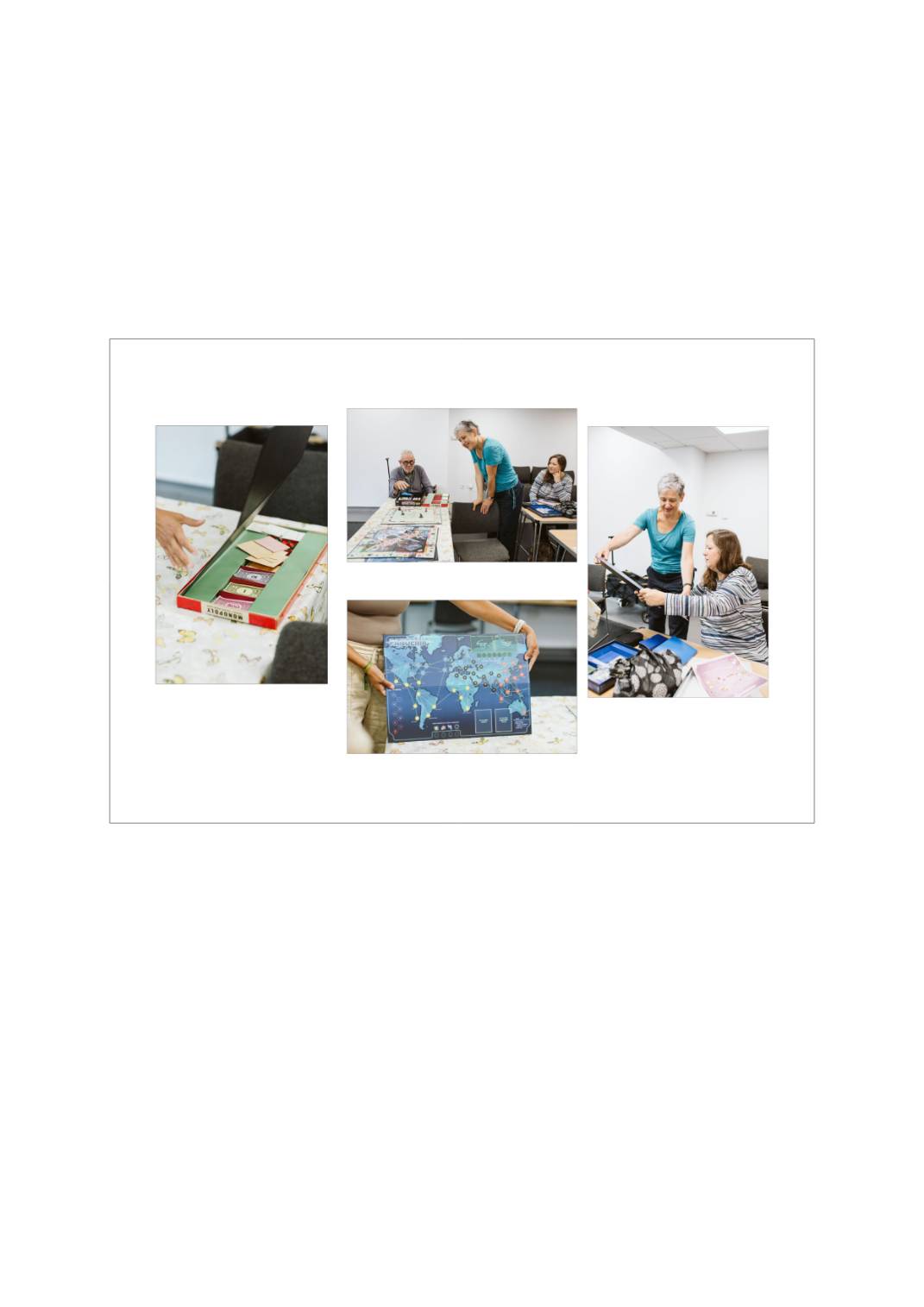
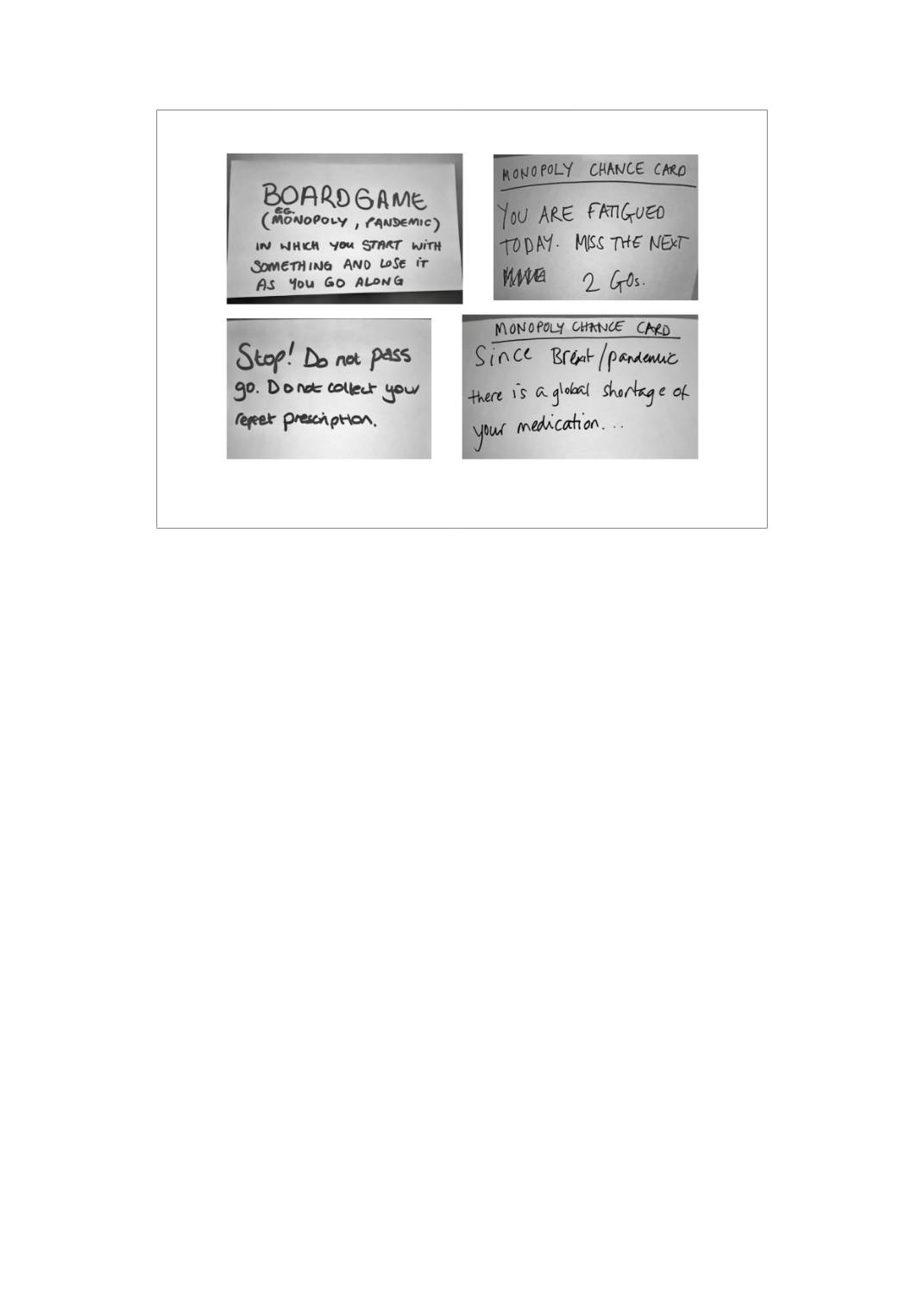
The collaborative work would consist of a central interactive piece which engaged
in a board game, reflecting a similar concept to that of Monopoly or Pandemic.
Proposed structure
Exhibition planning
© AS
Visitors, instead of a game of accumulating (wealth, points, etc.), or racing to be the
winner, would be exposed to the “Spoon Theory”; each throw of the dice presenting
them with the possibility of losing or gaining spoons, depending on the task they are
asked to complete. The piece would be tactile, and scaled such as visitors would
become the counters as they journey around the board game.
This piece would reflect the common themes identified in day one, refined
throughout the duration of the residency, and further consolidated as the
participants continued to develop work post-residency.
At the time of writing, this concept is under development.
 Page 27 of 40
Read page 27 as text
24 of 40
Day Two
Individual work
The group moved onto considering what individual or interdisciplinary work could
further represent themes that were more heavily weighted towards each participant’s
unique experience of incurable cancer.
There were nuanced differences in how each participant navigates the healthcare
system, employment, finances, relationships (romantic, familial, friendships,
professional, etc.), social interactions, feelings of belonging.
The group identified factors such as age at diagnosis, gender, ethnicity, relationship
status, fertility and/or parenthood, socio-economic background, as having an impact
on the perceptions of healthcare professionals, employers’ expectations, and
society in general, in turn affecting the decisions each had to take to overcome
obstacles in continuing to live and full life.
These discussions touched on subject and issues which are of a sensitive nature to
each participant. Participants expressed their frustration at not having an effective
forum for the rest of society to expand their understanding of the emotional impact
and practical consequences of living with their unique diagnoses and treatment
paths.
In practice each participant agreed to produce work (one to three pieces) which
addresses their unique perspective, exploring alternative media, and/or
collaborating with each other to explore innovative ways to execute ideas.
A concept under development
© AS
 Page 28 of 40
Read page 28 as text
25 of 40
Day Two
Closing Day Two
Participants closed day two of the residency with a short reflection guided by the
following questions:
•
What became clearer today?
•
What are you excited about?
•
What still needs thinking about?
The group also began to identify materials, equipment, space, technical support,
access requirements and anything that would need to be sourced, according to the
agreed structure of a future exhibition and the work that would emerge.
Community engagement was considered, thinking about ideas for making it possible
and what would be needed to execute it.
What would be considered a success, how would it be measured?.
The group agreed to build into the exhibition plan an element of community
participation, enabling audiences to respond to the works, making use of online
tools, for example a virtual gallery, as well as analogue forms such as drawing,
writing, and repurposing materials.
The group have maintained contact and met virtually to continue developing the
ideas that emerged during the residency. Further in person meetings are scheduled
in 2027.
 Page 29 of 40
Read page 29 as text
26 of 40
Day Three
Day Three
The purpose of day three was about taking care of the work already documented,
consolidation and looking outward. By the end of the day, participants would have a
portfolio of creative intentions to develop, a collective vision for how an exhibition
can communicate what it is to live with an incurable cancer diagnosis, ideas for
meaningful community involvement, a practical roadmap, and realistic commitments
to remain connected.
The group were also joined by Kathy Lett, a BACP registered psychotherapist who
would be facilitating some of the discussions for the day and be available to provide
emotional support to the participants.
Starting the day with reflecting on Our Manifesto, themes, and the exhibition
roadmap, participants took the opportunity to demonstrate to Kathy some of the
ideas emerging.
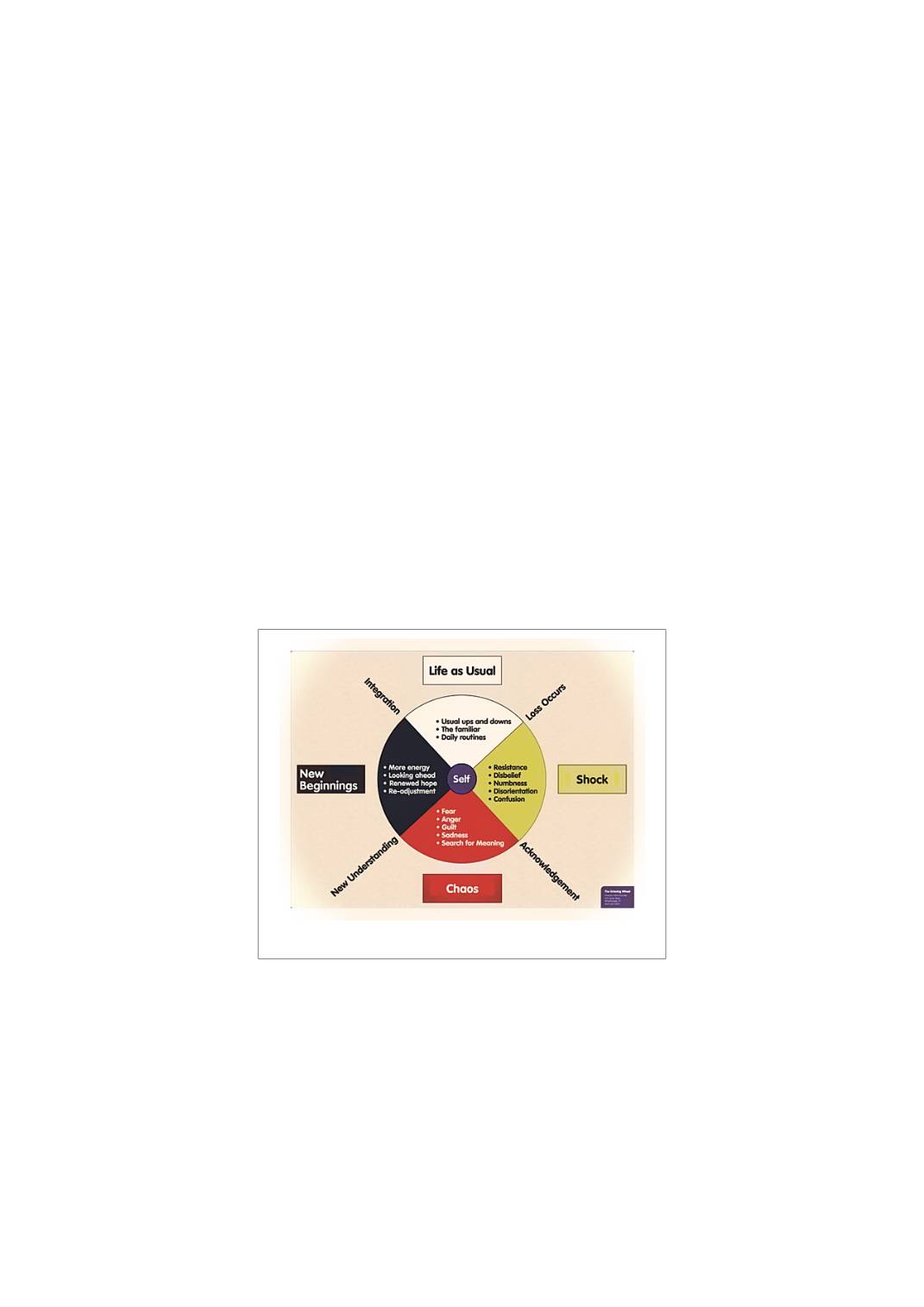
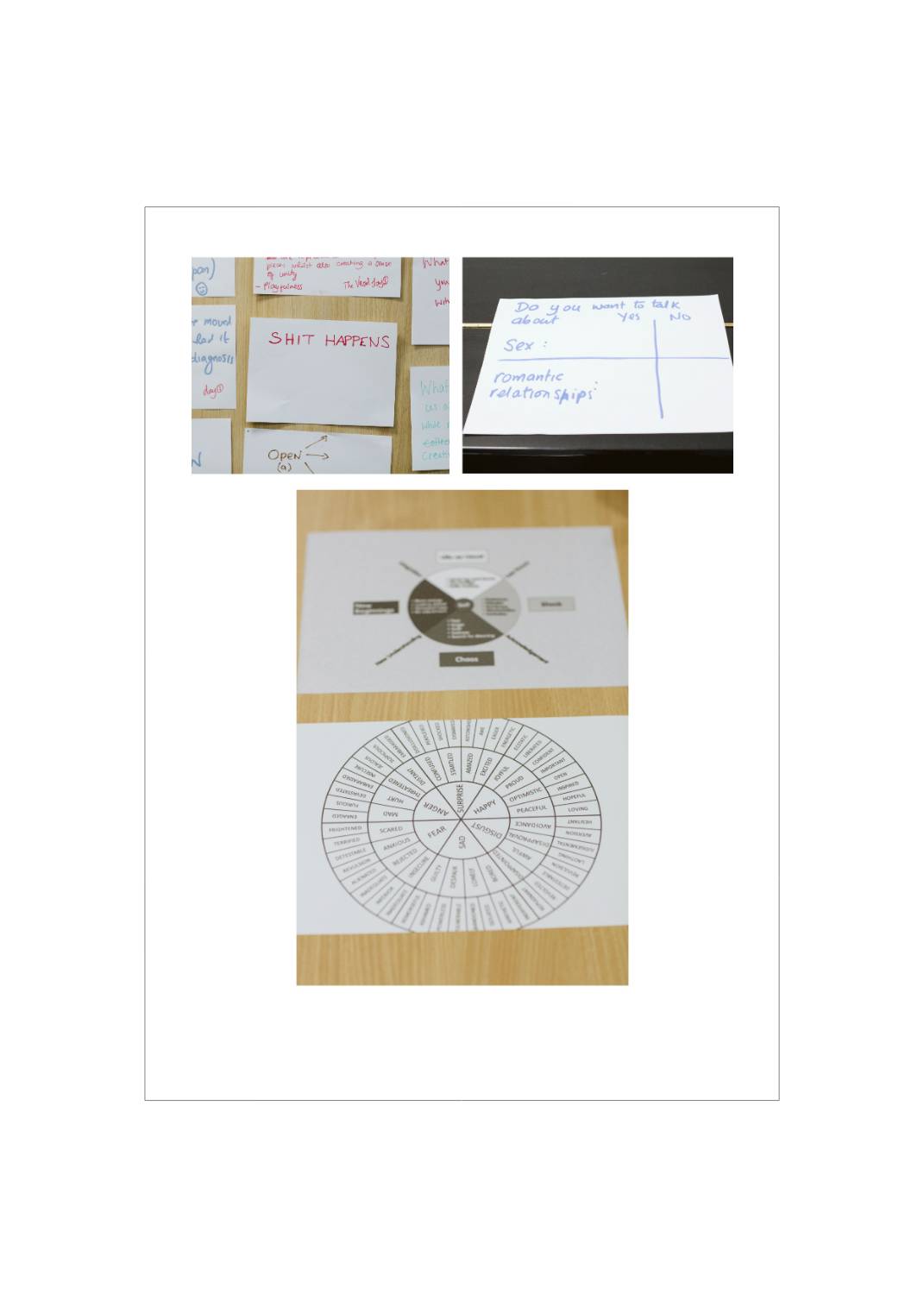
Kathy introduced the concept of “Wheel of Grief”, enabling participants to explore
whether their experiences of living with incurable cancer resembled the cyclical
nature of grieving. Participants welcomed being able to reframe their emotions and
feelings with a fresh perspective.
The project lead also provided the group with a chart of emotions to support further
discussions around navigating our diagnoses, the healthcare and benefits systems,
as well as the normal ups and downs of life.
Participants were encouraged to describe emotional states as a triad referring to the
chart, and expanding where/if necessary, whilst being reassured that opting out was
available to all of us.
The Wheel of Grief
© AS
 Page 30 of 40
Read page 30 as text
27 of 40
Day Three
Addressing emotions
© AS
 Page 31 of 40
Read page 31 as text
28 of 40
Day Three
Collaborative Making: Assemblage
The Evidence
This collaborative making activity focused on exchanging found objects, individual
interpretation and collective assembly as a form of story-telling.
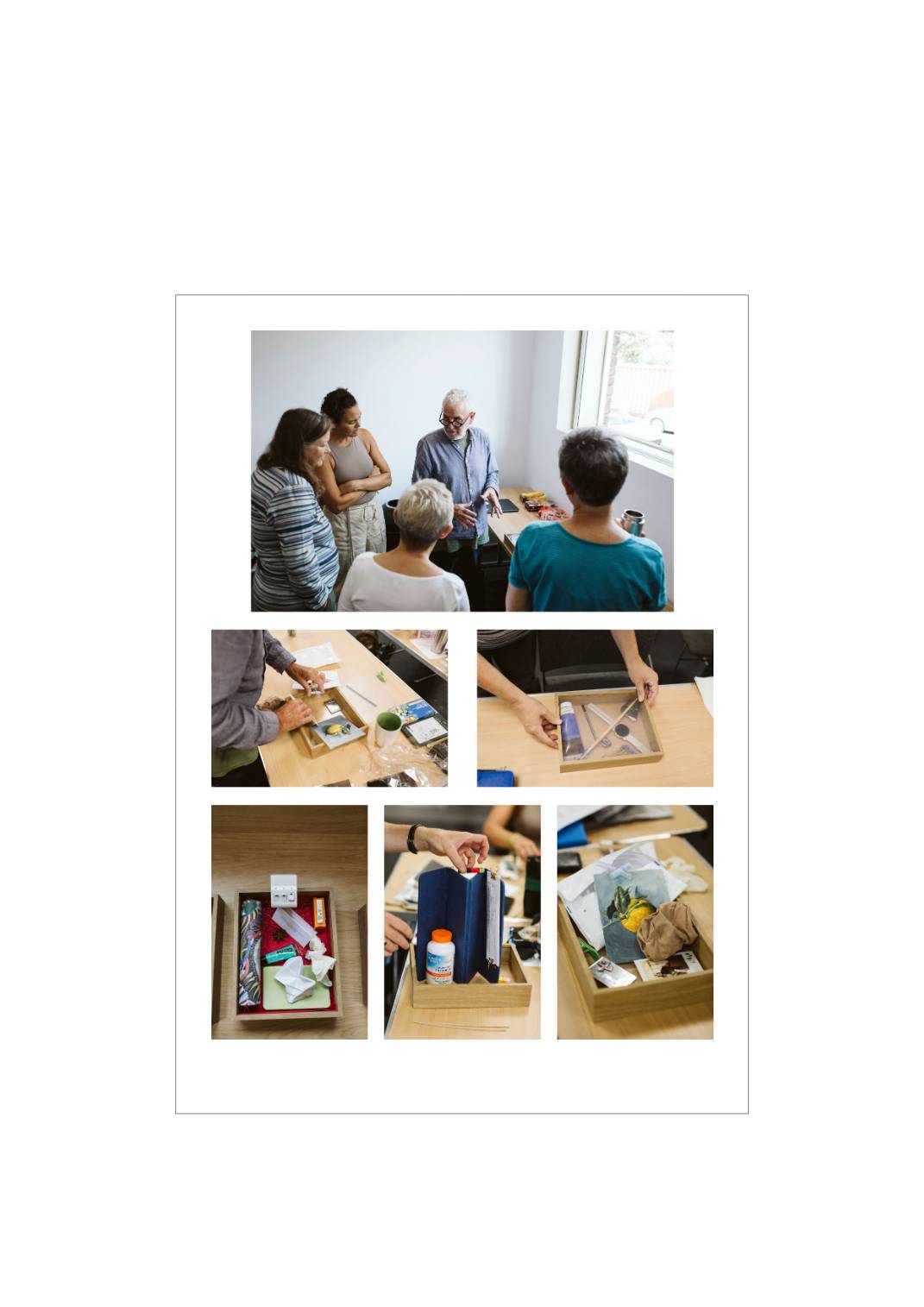
Participants were each provided with one small shadow box a central collection of
safe tactile found objects: beach stones, keys, fabric scraps, yarn, old game pieces,
tiles, gears, paper fragments and other small materials. They were also invited to
bring their own found objects which might have some significance for them, no need
to explain why.
Each participant was invited to choose five to seven objects that caught their
attention visually, texturally or intuitively; each choice representing what other
people see; something they don't see; something that has changed or been lost;
something ordinary or everyday; joy, humour, pleasure or love; uncertainty; or
something that keeps them connected to life.
The next step involved trading two objects with the other participants. The
exchanged materials then became part of their individual assemblage.
For the final step, each person was invited to arrange and secure the objects inside
their individual boxes, by layering, leaving negative space, adding simple
backgrounds, all changes were to be temporary and fully reversible.
Finally all of the shadow boxes were brought together as a grid so that separate
works become one collective assemblage.
Reflection
The group finished the activity with a reflection guided by the following questions:
•
Is there something in somebody else's section that connects with you?
•
How did exchanging materials alter what you thought you were going to make?
•
What can you see in the whole that you could not see in the individual pieces?
•
What does this collective object tell us about the three days we have spent
together?
The group remarked how the activity reflected each person’s personality and
creative process, expressing the many facets of a person through temporary
“collage” sparked ideas and desire for exploration, as well as a being a safe platform
from which one could imagine experimenting with diverse media.
 Page 32 of 40
Read page 32 as text
29
Day Three
Collaborative Making: Assemblage
© AS
The accessibility of working with found objects made it a useful tool for future idea
generation.
Having to “trade” objects with other participants, albeit briefly and temporary,
provided and element of jeopardy, which stretched the imagination.
 Page 33 of 40
Read page 33 as text
30
Day Three
Imagining the Exhibition
All of the activities in which the group engaged, the discussions, the idea generation,
and the collaborative making, culminated in a skeleton map for a future exhibition
which all of the participants agreed would contribute towards the aim to the project:
As we continue to work together the following criteria will inform the structure,
format, delivery, and promotion of future exhibitions.
•
What should people experience?
•
What should people understand?
•
What should people feel?
•
How should people participate?
•
Who isn't in the room yet? How do we reach them?
•
What might happen beyond the gallery walls?
The process of creating will involve appropriate opportunities for evaluation,
adjustment, and where appropriate responding to the audience’s experience.
As a group we are keen to engage with health service professionals, charities,
people living with incurable cancer and their loved ones, policy makers, local
government, and culture networks.
“To create opportunities for artistic
expression, collaboration, and conversation,
placing lived experience at the heart of the
creative process.”
What next?
The project lead continues to explore funding opportunities beyond the current
crowdfunding campaign to ensure creatives and collaborators involved in the project
are fairly remunerated for their input, time, and skills.
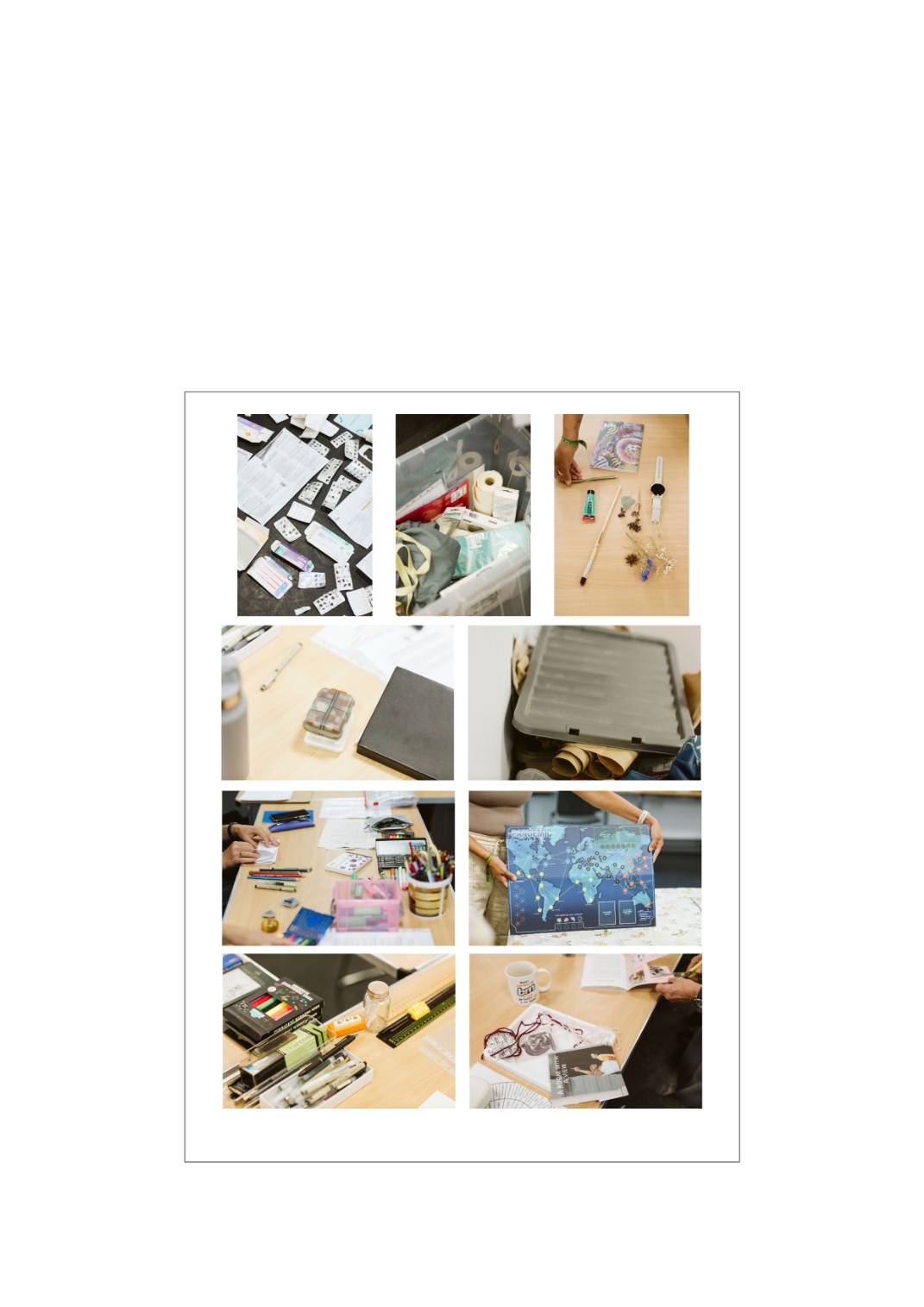
The three-day residency was delivered using mostly recovered and reused materials,
sourced from local charities and the author’s own archive.
 Page 34 of 40
Read page 34 as text
31
Day Three
Wherever possible, participants will attempt to incorporate recovered materials to
execute their ideas.
Community engagement activities will seek to include people who might not feel
that arts or creativity is for them and will provide a platform for audience
participation.
People living with incurable cancer can at times face barriers to access creative
opportunities and cultural experiences. The project lead is committed to engaging
with arts organisations across Dorset with a view to delivering the concept in some
of the most rural areas of the county.
Working with recovered materials
© AS
 Page 35 of 40
Read page 35 as text
32
Feedback
Participant feedback
Participants completed reflection forms before the residency and evaluation forms
afterwards. This made it possible to compare their hopes and concerns with their
experiences over the three days. These responses represent the three participating
artists other than the author.
Before the residency, participants hoped to meet other artists, share experiences,
work together, and develop ideas for an exhibition. They wanted to make work they
felt proud of and begin a creative process together.
Some felt uncertain about their artistic abilities or nervous about meeting new
people. One participant wanted more clarity about how the residency would lead to
an exhibition and when it might take place. Participants also asked for room to
express different experiences and ways of working, and flexibility to manage their
health needs.
Changes in confidence and connection
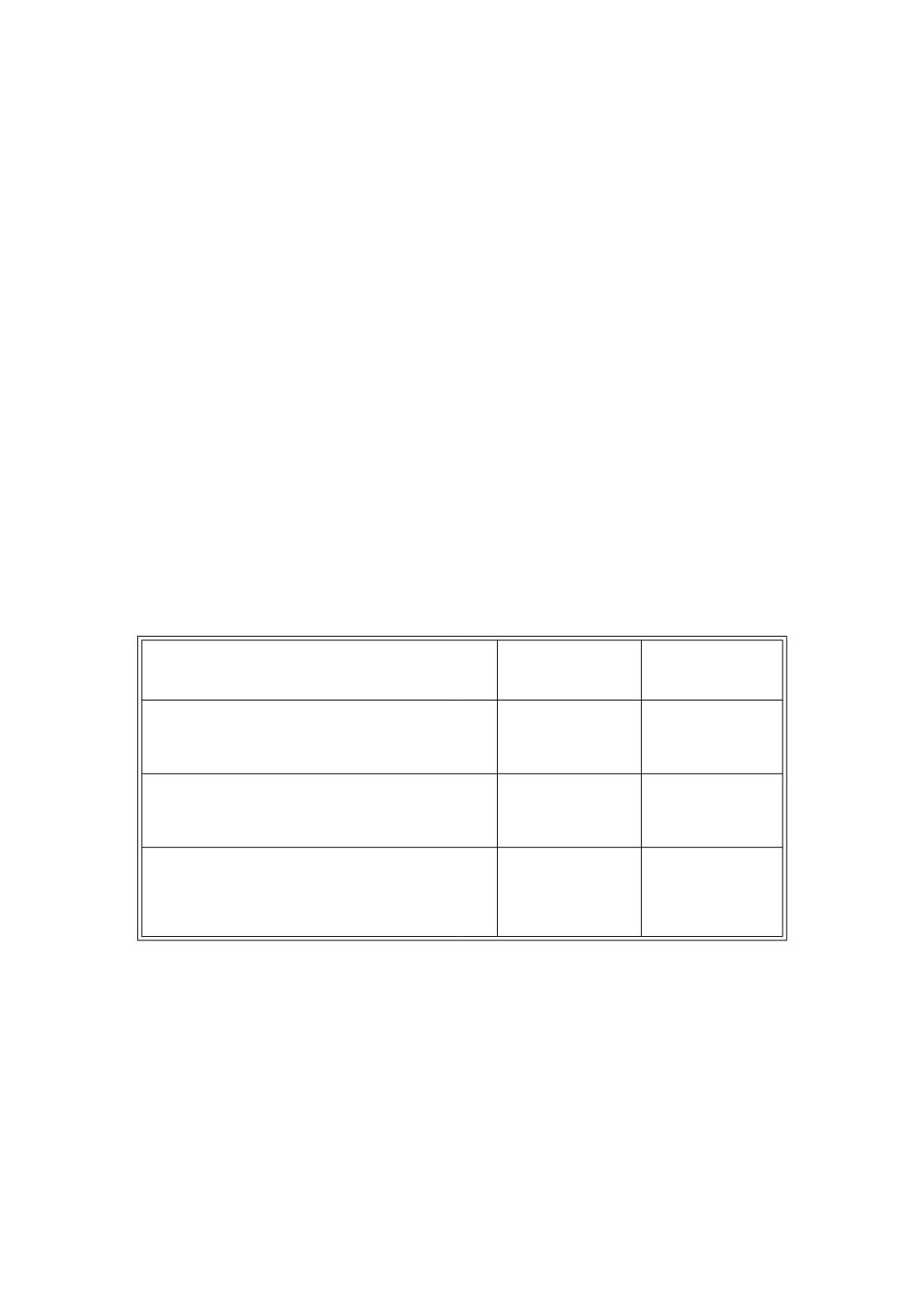
Participants chose a score from 1 to 5 for each question, with 1 being the worst
rating and 5 the best. The table shows the average scores across the three
participants, rounded to one decimal place.
Question
Before the
residency
After the
residency
How confident do you feel in your
creative practice?
1.7
4.0
How connected do you feel to other
artists or a creative community?
1.7
4.3
How comfortable do you feel sharing or
exploring lived experience through your
creative practice?
2.7
4.3
All three participants felt more confident in their creative practice and more
connected to other artists after the residency.
Two participants also felt more comfortable exploring lived experience through their
art. Their scores rose from 1 to 5 and from 3 to 5. The third participant’s score fell
from 4 to 3. The feedback does not explain this change. Continuing to give
participants choice over what they share, and how they share it, remains important.
 Page 36 of 40
Read page 36 as text
33
Feedback
What participants valued
Participants described gaining inspiration, new ideas, friendships, and freedom to
experiment. The creative exercises and conversations helped them respond to one
another’s work and explore different ways of making.
Participants were struck by how well the group worked together. Sharing personal
objects and their meanings also left a strong impression. The feedback highlighted
the value of play, spontaneity, and having space to explore emotions through art.
“Inspiration,
connection with
other artists,
learning new
things about
myself and new
ways of being
creative and
making things”
Taking the work forward
All three participants identified new relationships or opportunities to collaborate.
They wanted to continue meeting, share ideas developed after the residency, work
on the collective board game, and create individual artworks. These responses show
that the residency helped the group establish connections and a direction for future
work. Further meetings will help turn those ideas into pieces for the exhibition.
Learning for future residencies
The feedback offered practical suggestions for
improving the experience.
•
Explain clearly whether personal objects used in
an activity will be changed temporarily or
permanently.
•
Consider a longer residency. One participant
suggested five days, allowing a slower pace,
more conversation, and more time to make.
•
Keep future meetings and activities flexible,
recognising that treatment may affect a
participant’s availability.
The author views the feedback as an encouraging
account of what the three days made possible.
Participants left with greater creative confidence, stronger connections, and ideas
they wanted to pursue together. Staying in touch will help establish how these early
outcomes develop into continued collaboration and completed artworks.
 Page 37 of 40
Read page 37 as text
34
Acknowledgments
I would like to express my gratitude to The Lighthouse for reading my proposal and
believing in my ability to deliver this project. The opportunity to turn ideas into
something tangible, besides being present for my children, is what continues to
motivate me to get out of bed every day.
Realising “Not Dead Yet?” has challenged me in ways that I had not envisaged. In
my Sanctuary 2026 application I proposed to bring together a cohort of people with
two things in common, cancer and creativity, to challenge preconceived notions of
of life with incurable cancer.
Which leads me to the three other creatives who joined me for those three days in
early September.
I am so grateful that they took the risk to apply, and trusted me to guide them
through this process of collaborating, creating, and connecting.
From their very immediate feedback, the residency delivered much more than they
ever expected, and I can say this is the case for me too, I had high expectations of
myself. Those expectations were exceeded I believe because of the high quality of
participants who were engaged, eager, and willing to participate in each of the
activities, with enthusiasm, respect for each other, giving and receiving constructive
feedback.
I have also had the privilege of being supported by Kathy Lett and Alexandra Szigeti,
who both did not hesitate to say yes when I approached them to get involved in the
project. They have contributed their time and skills without expecting any
remuneration, and have been kind, considerate, warm, and generous with their
advice and patience. Thank you so much Kathy and Alexandra, I will make it up to
you with coffee and cake!
The residency wouldn’t have been possible without the financial contribution of the
many people who have backed the project’s crowdfunding campaign. Some are
known to me, others complete strangers who believed in the project. It is reassuring
that people are willing to hand over their money to make sure the project is
successful.
Marbellys Bayne
Project Lead
Acknowledgments
 Page 38 of 40
Read page 38 as text
i
Index
Index of Images
by Alexandra Szigeti
“…a base, hollow, curve, wall…” ............................................................. 14
A boat in clay ........................................................................................... 15
A concept under development ................................................................. 24
A snake slumbers .................................................................................... 16
A stranded maid? .................................................................................... 16
Adding to the “beginning” ........................................................................ 13
Addressing emotions ............................................................................... 27
Collaborative and multidisciplinary creativity ............................................... 2
Collaborative Making: Assemblage .......................................................... 29
Collaborative Making: Clay ...................................................................... 14
Creating “The Vessel” .............................................................................. 15
Creativity in clay ....................................................................................... 16
Documenting ideas .................................................................................... 2
End of day one reflections ....................................................................... 10
Exhibition planning ................................................................................... 23
Four small-scale clay sculptures .............................................................. 15
Hands moulding clay ............................................................................... 16
Honesty, a theme embraced by participants ............................................ 21
Is it a crab? .............................................................................................. 16
Our Manifesto ............................................................................................ 9
Pondering the environmental impact of cancer care ................................. 20
 Page 39 of 40
Read page 39 as text
ii
Index
Sharing reflections on creating with clay .................................................. 17
The finishing touches ............................................................................... 17
The Vessel taking shape .......................................................................... 14
The Wheel of Grief ................................................................................... 26
Three months’ worth of medicines’ packaging ......................................... 19
Working with recovered materials ............................................................ 31
by Marbellys Bayne
“Circulation”; a common theme identified .................................................. 6
“Landscape of the Mind” ........................................................................... 2
Diverging direction of travel ........................................................................ 7
Drawing revealed with everyone’s contribution ........................................... 6
Individual marks merge into a shared drawing ........................................... 5
Naming experiences .................................................................................. 4
Reflections on creating with clay .............................................................. 18
Toxic positivity, often experienced by participants ...................................... 4
Participants feedback
Our Manifesto ............................................................................................ 9
Our voices (unique and diverse) ............................................................... 16
Uniqueness of opportunity ......................................................................... 3